
 Brawl Stars

Imagine early summer 2017. Somewhere in the App Store, only available to Canadians, a game with cartoonish graphics and a strange name quietly appears: Brawl Stars. No global advertising, no streams to an audience of millions. Supercell simply soft-launched its new experiment and waited to see if it would survive.
Exactly nine years later, this game attracts around 50 million active players per month and has long since become one of the most profitable mobile titles on the planet. But the road to getting there was much more challenging than it seems.
IT WAS A DIFFERENT GAME
Brawl Stars, which launched in beta on June 15, 2017, bore little resemblance to the one you play today. In its early days - before the public beta - the project had the working title Project Laser and operated in portrait (vertical) orientation. Players tapped the map to move, the controls were cumbersome, and battles themselves turned into awkward fumbling when an enemy appeared "below" the screen - their fingers simply blocked their view.
The theme also changed from the very beginning until artist Paul Chambers suggested switching to the Wild West - and in one weekend, he sketched out ten new cowboy-style characters. Many of them made it through to the beta and remain in the game to this day.
Before the global launch, Supercell reworked the controls: the game switched to landscape (horizontal) mode with a joystick (since March 9, 2018), removed the stealth mechanic (previously, enemies were not visible through walls), and added "superabilities" that charge based on damage dealt.
ONLY 15 BRAWLERS. REMEMBER THEM ALL?
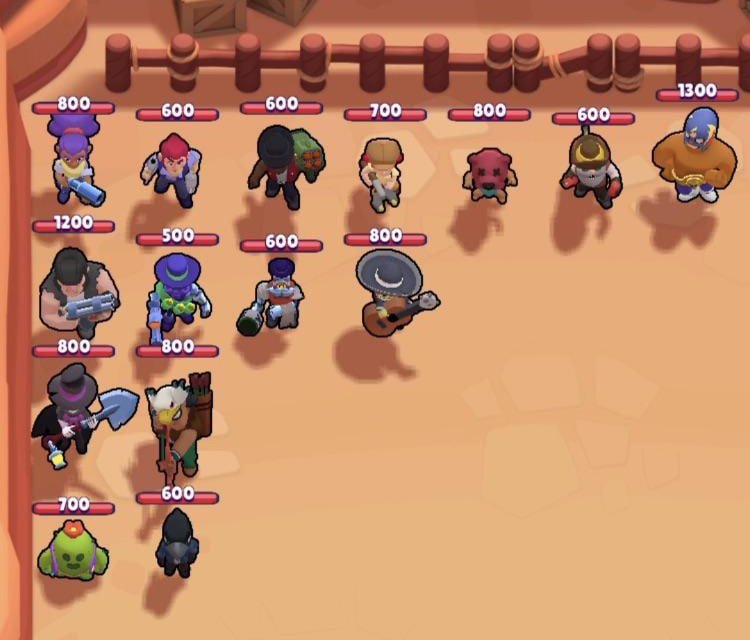
On the day of the beta launch, there were exactly 15 brawlers in the game. Today, there are over a hundred - but back then, that was the entire Brawl Stars world. Let's recap:
Common: Shelly, Colt, Nita, Dynamike, El Primo - the foundation. Shelly was given to everyone at the start, Colt unlocked at 60 Trophies, Nita even earlier.
Rare: Bull, Brock, Barley, Jessie - the first "trophy" unlocks that felt like a true victory.
Super Rare: Ricochet (later renamed Rico) and Poco.
Epic: Bo and Mortis - Bo required players to reach 3000 Trophies, which seemed almost impossible back then. Mortis was Epic. Later, thanks to Tara's release, Mortis would become a mythical character.
Legendary: Spike and Crow are two characters that were pretty cool to get back then!
WHAT IT LOOKED LIKE AND HOW IT WORKED
Visually, the game was bright and cartoonish from the start - Supercell's signature style with clear outlines, rich colors, and large, easy-to-read characters. The maps were small, the bushes were dense, and walls could be destroyed with supers like Brock's.
But the progression system was completely different. Instead of today's coins, Power Points, and Brawl Passes, there were Chips and Brawl Boxes. You earned Chips by playing matches, saved them, opened the boxes, and from them, Power Points for upgrading your brawlers, coins, or, if you were lucky, a new character would randomly drop. 100 Chips = 1 regular box. Sometimes you'd spin it, and inside you'd find a simple elixir for a bull you didn't have yet. It was a shame, but it was exciting.
Some brawlers were unlocked not from boxes, but through the Trophy Road - a system of trophy milestones. Reach 15 trophies and you'll get Nita. 60 - Colt. 250 - Bull. 1000 - Brock. 2000 - Dynamike. 3000 - Bo. It was a clear goal, visible on the horizon: "Just a little more, and I'll unlock the next one."
There were fewer modes. Gem Grab unlocked immediately, Showdown - at 35 trophies. Bounty, Heist, and Brawl Ball appeared later in the rotation. No Knockout, Hot Zone, or anything else - just the basics. But each mode felt like an event: the maps rotated on a schedule, and if you missed Heist, you had to wait for the next rotation.
Star Powers - unique passive abilities - were added later in the beta, in updates. Back then, it felt revolutionary: every brawler got something unique, radically changing their playstyle.
522 DAYS IN THE SHADOWS
The Canadian beta lasted 522 days. For a mobile game, that's an eternity. Supercell took its time: the company monitored player behavior, tweaked mechanics, and trimmed unnecessary features. According to some reports, there were doubts within the studio itself: would the game even make it to the global market?
During the soft launch, the game earned around $6.5 million - modest by Supercell's standards, for whom Clash of Clans and Clash Royale were already billion-dollar franchises.
And yet, on December 12, 2018, Brawl Stars launched globally - on both iOS and Android. With over 5 million pre-registrations, the game brought in $63 million in the first month alone.
RISE, FAILURE, AND A SECOND WIND
The history of Brawl Stars isn't a straight line upward. The euphoria of its global launch was followed by years of instability. The game was searching for its place: mode rotation, new brawlers, a reworked progression system. In 2022-2023, monthly revenue often hovered around $5-10 million - a tenth of its peak.
But then something clicked. 2024 became Brawl Stars' best year ever, with annual revenue reaching $678.5 million. In April 2024, the game was earning $72 million per month. The number of active players at its peak exceeded 50 million.
Today, nine years into its beta, Brawl Stars has over 545 million lifetime downloads and over $2.3 billion in total revenue. As of May 2026, the game has earned almost $50 million and is the leader in revenue and downloads among the company's other games.
WHAT MADE THE GAME SO COMPELLING
Brawl Stars has several features that set it apart from hundreds of competitors.
Constant updates. Brawlers, modes, seasons, collaborations - Supercell has never let the game sit idle. The roster has grown from 15 characters in the beta to over 100 unique brawlers today.
Esports. The Brawl Stars Championship has become a full-fledged international discipline. The Worlds 2024 final attracted approximately 1.1 million concurrent viewers. Over 210 tournaments have been held, with a total prize pool of over $9 million.
Community culture. The game has become part of internet culture - memes, fan art, YouTube content. When MrBeast made a themed video based on Squid Game with Brawl Stars references, the game garnered approximately 1.4 million new downloads in six days.
NINE YEARS AND STILL GOING STRONG
In the world of mobile games, nine years is practically a geological epoch. Most titles fade away within two or three years. Brawl Stars has survived several crises, several metagame shifts, and returned. Not because it has a perfect formula, but because Supercell wasn't afraid to break it and rebuild it.
That small Canadian beta from June 2017 wasn't the beginning of a success story. It was the start of a very long experiment - with 15 characters, chips, boxes, cowboy maps, and controls that weren't quite sure what they wanted to be. The experiment is still ongoing.
Happy birthday, Brawl Stars. Nine years is just the beginning🥳
Share this article