 Brawl Stars
INTRODUCTION
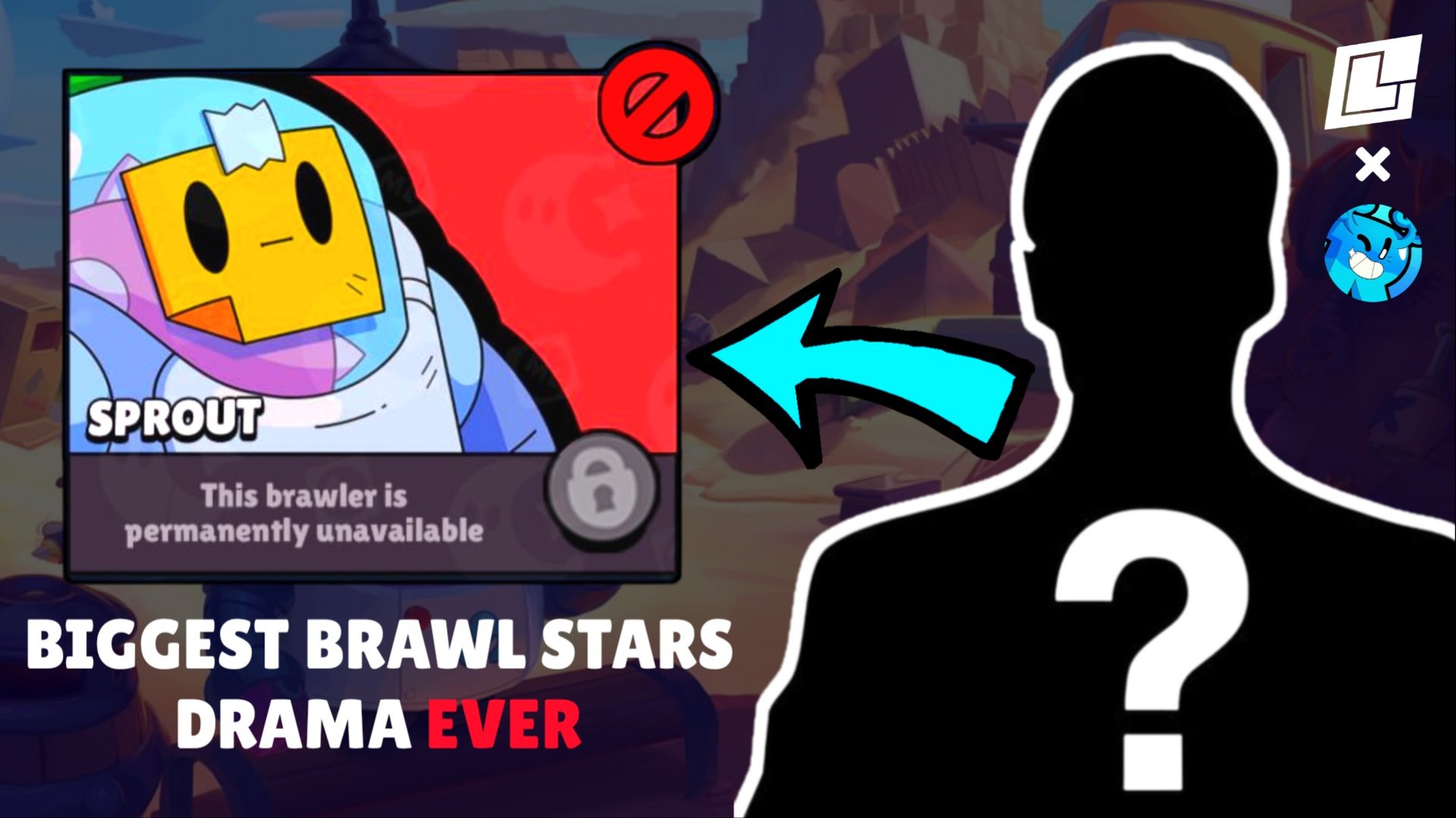
Over the nearly eight-year history of Brawl Stars, like other games, there have been various dramas and scandals. These have involved everyone: various well-known players and creators, as well as developers for updates that sparked major controversy in the community. Perhaps the biggest drama in the game before recent events was the removal of crates in December 2022, which radically changed the game forever. Before that, a major scandal was the 140 Mega Boxes for $2 promotion, which led to the game's Play Store ratings hovering around 1.5 stars and a huge amount of hate from the community. However, the recent event has arguably become the biggest drama in the game's history, leading to a complete overhaul of Sprout.
In this article, Gamerland Media, together with the official creator REN, have prepared a full report on the incident, in which we will delve into this story in detail and attempt to reveal it from various angles.
1. HOW THE STORY STARTED - COMMUNITY DISCOVERY
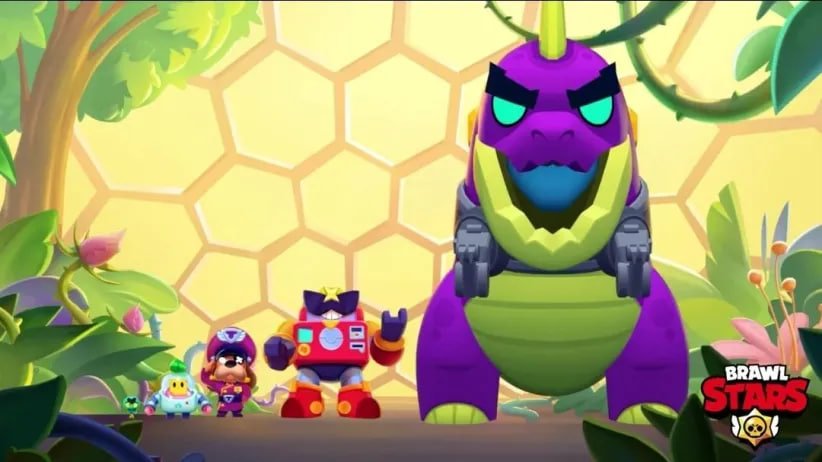
The incident began when players noticed that a tweet from the official Brawl Stars account, posted on March 22, 2022, had been deleted. This disappearance was found by one user on X (@ruffsxevecanon). The tweet contained a clip showing the heights of several Brawlers (Eve, Sprout, Ruffs, Surge, and Kaiju). Community members speculated that the deletion might be related to changes in lore or character relationships.
Shortly after, another user (@H_dile5) found that at least two more tweets had been removed, including one featuring an illustration for the game’s 7‑year anniversary. Those tweets included references to the relationship between Bo and Charlie - a pairing that was not originally present but was developed after a community event in February 2025. Some players theorised that Supercell might be retconning lore elements, though others questioned why the anniversary tweet would be deleted for such a minor detail.
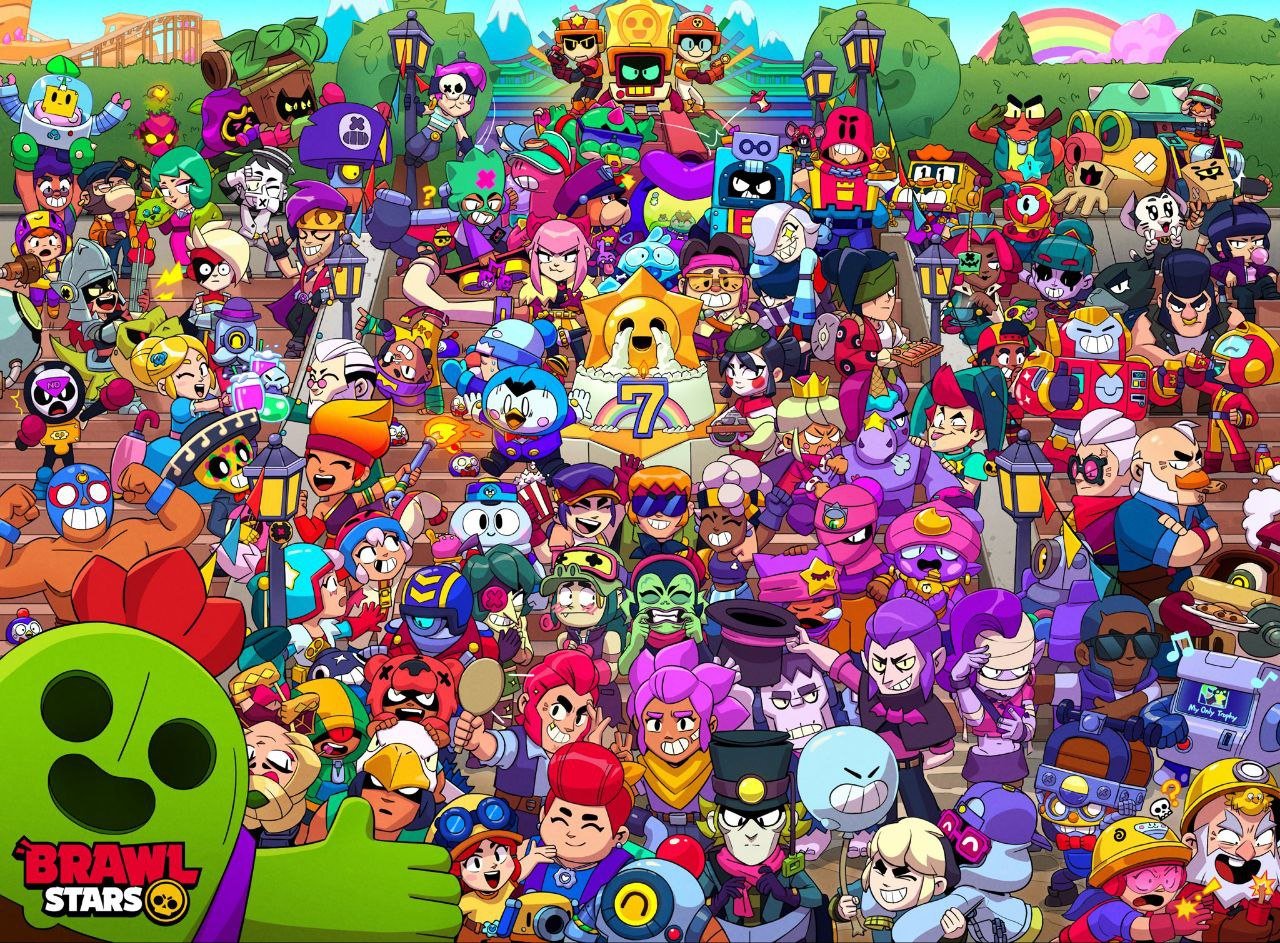
Subsequently, a community member (TeapotDragon) noticed that all the deleted tweets shared a common element: the presence of Sprout. This pattern led to speculation that Sprout was the reason for the removals.
Soon after, a Reddit user discovered a French court ruling on an official legal website, indicating that Supercell had been sued over Sprout’s design and was required to change it. This discovery connected the deleted tweets to ongoing litigation.
2. WHO IS ANDREA AND ITS DESIGNER
The plaintiff in the case is Mathieu Lehanneur, a French designer whose work often combines science, technology, and nature. Together with David Edwards - an American biomedical engineer and former Harvard professor - Lehanneur created an air purifier named "Andrea".

The purifier, which functions as a "living air filter" using indoor plants to absorb toxins, was the subject of a patent application filed on October 8, 2008, and was marketed starting in 2009. It received the Popular Science Best Invention Award in 2008 and is part of the permanent collections of the Museum of Modern Art (MoMA) in New York and the Museum of Decorative Arts in Paris. The product was originally named "Bel‑Air" but was later renamed "Andrea" for legal reasons.
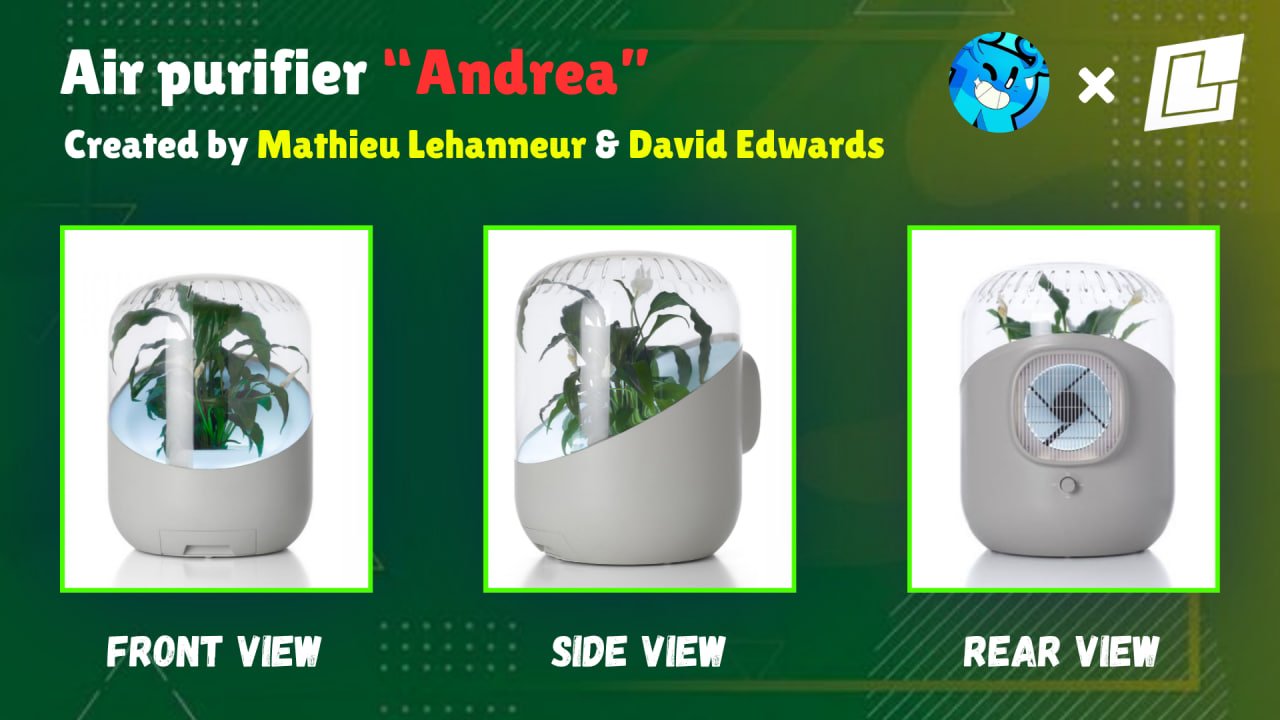
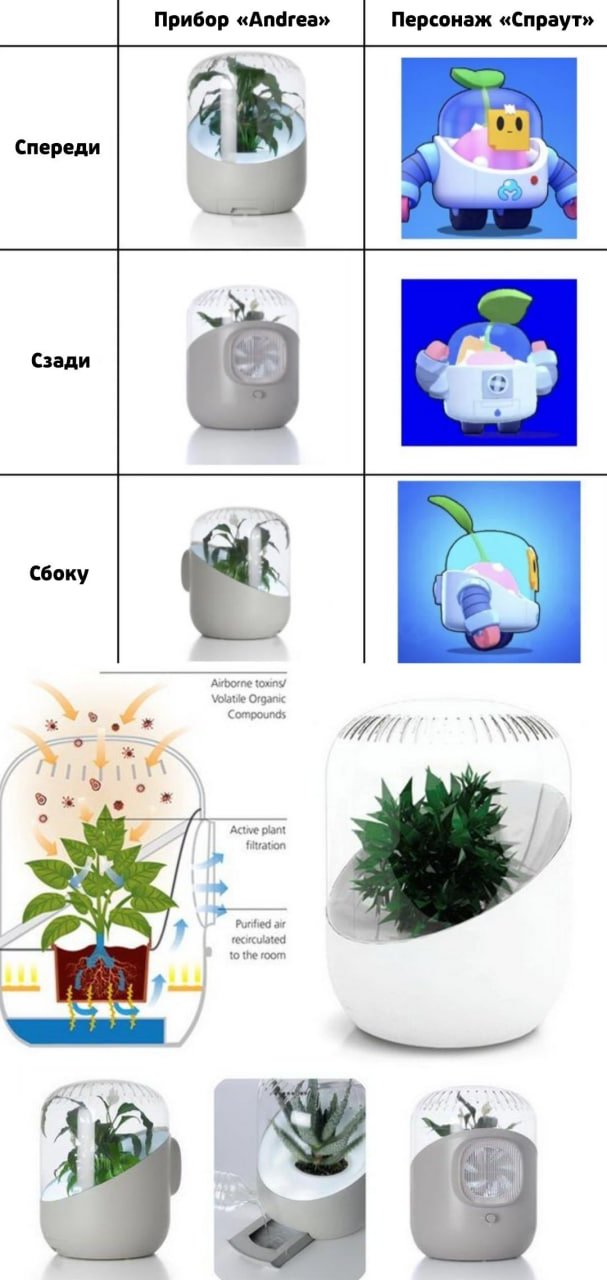
The design is a cylindrical, two‑part object with a beveled junction, a fan behind a grille, and a recessed handle for a water drawer - elements that the plaintiff later argued were original and protected by copyright.
3. PRE‑TRIAL COMMUNICATIONS
April 10, 2020 - Supercell added Sprout to Brawl Stars as a robotic assistant caring for plants in the Biodome.
June 2020 - Lehanneur contacted Supercell, alleging that Sprout’s design infringed on the Andrea purifier and requested that Supercell cease using it. The details of Supercell’s initial response are not publicly documented, but the claim was not resolved at that stage.
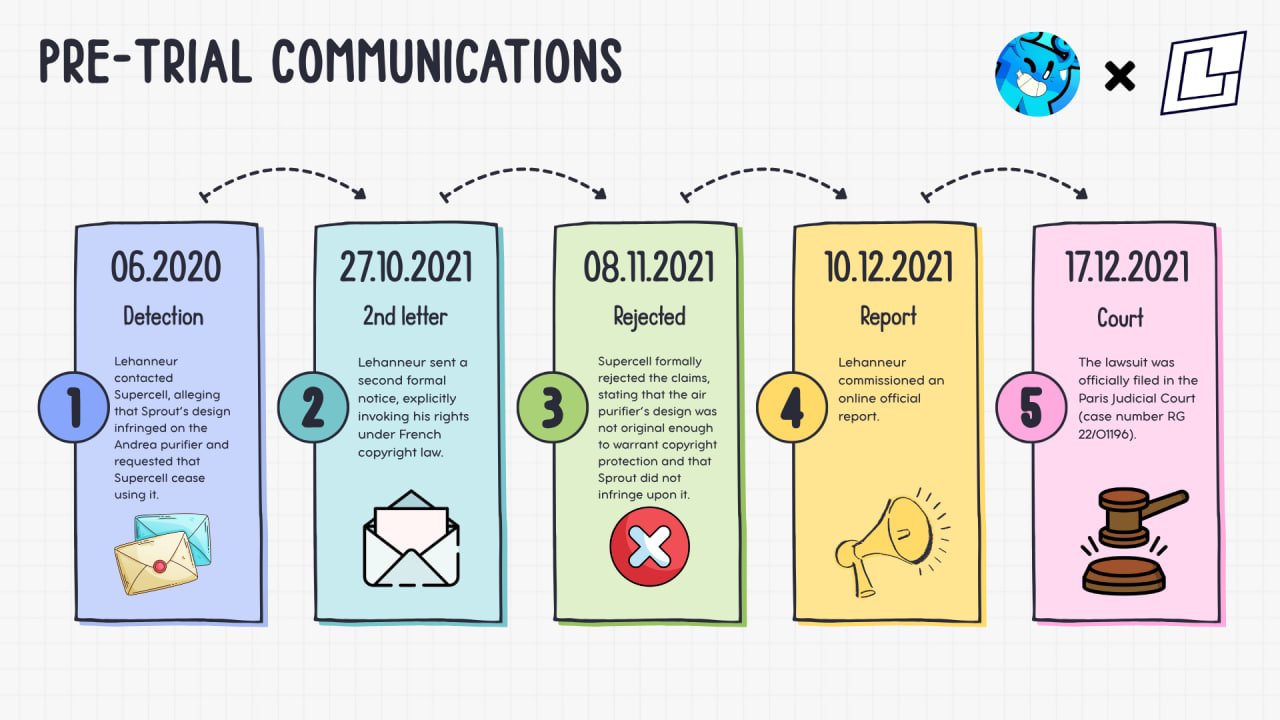
October 27, 2021 - Lehanneur sent a second formal notice, explicitly invoking his rights under French copyright law.
November 8, 2021 - Supercell formally rejected the claims, stating that the air purifier’s design was not original enough to warrant copyright protection and that Sprout did not infringe upon it.
December 10, 2021 - Lehanneur commissioned an online official report.
December 17, 2021 - The lawsuit was officially filed in the Paris Judicial Court (case number RG 22/01196).
4. LAWSUIT TIMELINE AND REASONS FOR THE FOUR‑YEAR DURATION
The case proceeded through the French court system from December 17, 2021 to December 4, 2025, when the final decision was issued.
Several factors contributed to the length of the proceedings:
- Determining copyright eligibility - The court had to assess whether the design of a functional object (an air purifier) could be protected by copyright, which requires separating purely utilitarian features from aesthetic, creative choices.
- Co‑authorship dispute - Because the purifier was created by two individuals, Supercell argued that Lehanneur lacked standing to sue alone. The court eventually ruled the claim admissible.
- Financial disclosure requests - The plaintiff sought access to Supercell’s financial records regarding revenue generated by Sprout in France from April 2020 onward, to calculate damages.
- Evidentiary review - The court examined concept art, patent documents, and conducted detailed visual comparisons between Andrea and Sprout.
The final ruling was delivered on December 4, 2025.
5. ANALYSIS: ARGUMENTS OF BOTH PARTIES AND THE COURT’S DECISION
Arguments Presented by the Plaintiff (Lehanneur)
- The Andrea purifier has a distinctive cylindrical shape, a beveled separation between two sections, a recessed handle, and a fan placement that are not dictated solely by function - they reflect creative choices.
- Sprout’s final design shares these same features to a high degree.
- Early concept art of Sprout (submitted by Supercell during the trial) showed a significantly different shape, and the design evolved toward the Andrea‑like form later in development - suggesting deliberate borrowing rather than coincidence.
- The plaintiff requested recognition of copyright infringement, cessation of use, and compensation for lost licensing fees and moral damages.
Arguments Presented by Supercell
- The air purifier’s design is primarily functional and therefore not eligible for copyright protection.
- The US patent for the purifier describes a filtration process, not a specific ornamental design, implying that the shape is not uniquely creative.
- Any similarities between Sprout and Andrea are coincidental and result from common design elements (cylindrical forms, fans, plants) that are in the public domain.
- Sprout includes many distinctive features (claw arms, wheels, a paper face with tape, plant leaves, a sticker) that distinguish it from the purifier and make the overall impression different.
The Court’s Findings and Decision
The court examined the originality of Andrea’s design and concluded that the following elements were not purely functional and reflected the author’s creative freedom:
- The cylindrical, rounded shape composed of two parts with a bevel at the junction.
- The almost invisible recessed handle for the water drawer.
- The fan placed behind a grille with softened edges.
- The overall decorative ensemble where aesthetics prevail over utility.
The court noted that the US patent cited by Supercell shows multiple possible embodiments, and only one matches Andrea’s design - indicating that the specific form was a matter of choice, not necessity.
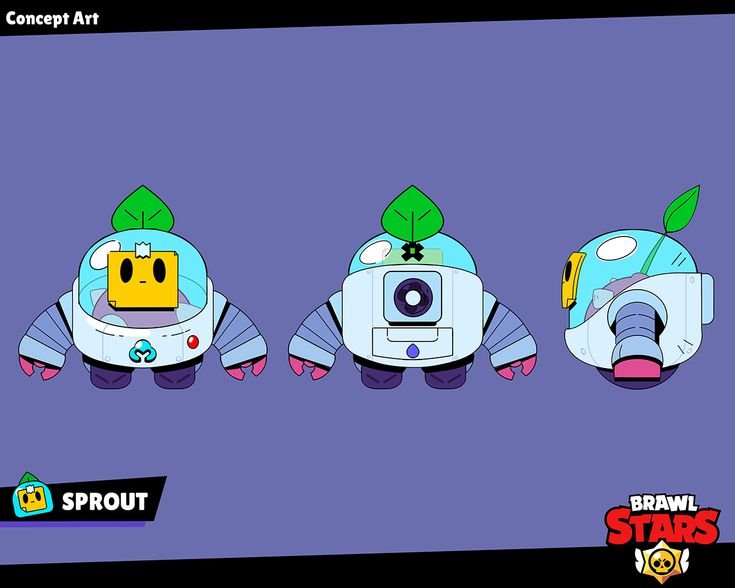
Comparing Sprout to Andrea, the court found:
- The body shape (cylindrical, rounded top, flattened bottom) was identical.
- The diagonal line on Sprout’s body (even if slightly curved) was strongly similar to Andrea’s bevel.
- The set of attributes (plant, fan, top opening, water reservoir) corresponds to an air‑filtration system, which is not a typical feature of game characters.
- The placement of these elements (except the water reservoir, which is at the back on Sprout rather than the front) is nearly identical.
The court also emphasised that the added elements (arms, wheels, face) do not obscure the copied core. The early concept art showed that Sprout originally had a different shape, and the final version was changed to a form closer to Andrea - which the court considered evidence against a claim of coincidental similarity.
As a result, the court ruled in favour of Lehanneur, finding that Supercell had infringed his copyright and moral rights. The court ordered the following measures:
First, Supercell is required to pay a preliminary compensation of €250,000 for the lost licensing fee regarding Sprout. This amount is provisional; the final sum will be determined after Supercell provides financial reports detailing the revenue generated from Sprout since its release in France.
Second, the court awarded additional sums of €80,000 for moral damages and €40,000 for legal costs, bringing the total immediate financial obligation to €370,000, with the potential for further increases based on the revenue disclosure.
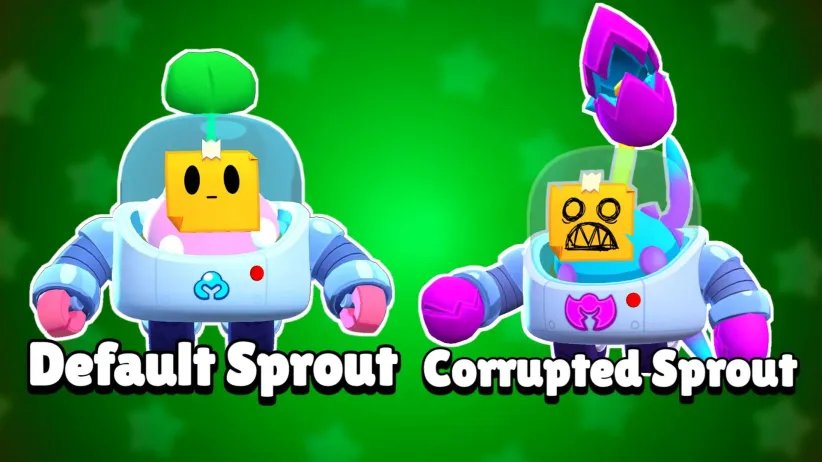
Third, Supercell must cease all use of Sprout’s default model and the "Corrupted Sprout" skin - which uses the same base design - in France. This cessation must take effect within one month of the court’s notification.
Fourth, a daily penalty of €1,000 will be applied for each day that the default model remains in the game or on official social media channels after the deadline, up to a maximum of one year.
Fifth, Supercell is obligated to stop all advertising campaigns and promotional materials featuring the current Sprout design.
Sixth, the court decision must be published on the homepage of Supercell for a period of 30 consecutive days.
Finally, the court prohibited Supercell from publicly announcing the case during the proceedings, as it could have caused significant public controversy and further exacerbated the moral harm claimed by the plaintiff. This restriction explains why the community had to discover the situation through independent research rather than through an official statement from the developer.
6. CONTROVERSIAL ISSUES AND UNRESOLVED QUESTIONS
The case raises several points that remain open to debate, even after the court’s ruling. These are not settled facts but rather questions that different observers might answer differently.
6.1. Originality of Andrea’s Design
The court determined that the design is original. However, some designers and legal commentators might argue that a cylindrical shape with a fan and plant is a common configuration for air purifiers, and that the specific elements could be seen as dictated by function rather than artistic expression. The court’s criteria for originality are binding in this case but may not be universally accepted.
6.2. Discontinued Product and Copyright
Andrea was marketed in 2009 but may no longer be in active production. Under French law, copyright protection does not depend on commercial availability, so the product’s discontinuation does not affect its protected status. Nevertheless, one could question whether a non‑commercialised design should enjoy the same level of enforcement as a product still on the market.
6.3. Motivation of the Plaintiff
The plaintiff sought both financial compensation and moral damages. While the court accepted his claims, it is possible to question whether the primary motive was to protect his artistic integrity or to obtain monetary gain. The court did not need to rule on motives - it only assessed the legal merits - so this remains a matter of speculation.
6.4. Was Supercell Aware of Andrea?
Supercell argued that the similarity was coincidental. The court rejected this based on the evolution of Sprout’s concept art, which changed toward Andrea’s shape during development. However, the court did not establish that any individual at Supercell had actually seen the Andrea purifier before designing Sprout. The finding of “conscious borrowing” is an inference from the design history, not direct evidence of knowledge. Therefore, the question of actual awareness remains unresolved.
6.5. The Weight Given to Body Shape vs. Distinctive Elements
The court focused heavily on the main body shape and considered the added features (arms, wheels, face, leaf, sticker) insufficient to create a different overall impression. Critics might argue that those additions are precisely what make Sprout a character rather than a household appliance, and that the court undervalued them. This is a subjective judgement that could be challenged in other jurisdictions or on appeal.
6.6. Jurisdictional Particularities
The case was heard in France, which has a strong tradition of protecting authors’ rights (droit d’auteur). A court in another country, such as the United States, might apply different standards - for example, requiring a higher degree of similarity or considering functional aspects more broadly. Thus, the outcome might have been different elsewhere.
7. WHAT HAPPENS NEXT
Supercell has confirmed through its Content Creator Program that Sprout’s model will be redesigned in an upcoming update, expected around June 30, 2026. The developers have stated that they are not permitted to discuss the remodel during Brawl Talk and will only mention it in patch notes.
Confirmed consequences:
- Sprout’s default model and the “Corrupted Sprout” skin must be removed from the game in France within one month of the notification.
- The daily penalty of €1,000 will apply if the model remains after that period.
- Official art and promotional materials featuring the current Sprout design will be removed or replaced.
- The court decision will be published on Supercell’s website for 30 days.
- Other skins (Tropical, Lunar, Ruby, Emerald) are not explicitly mentioned in the ruling and may remain unaffected, though Supercell may opt for a global redesign for consistency.
It is unlikely that Sprout will be removed from the game entirely. A redesign of the character model appears to be the most probable resolution.
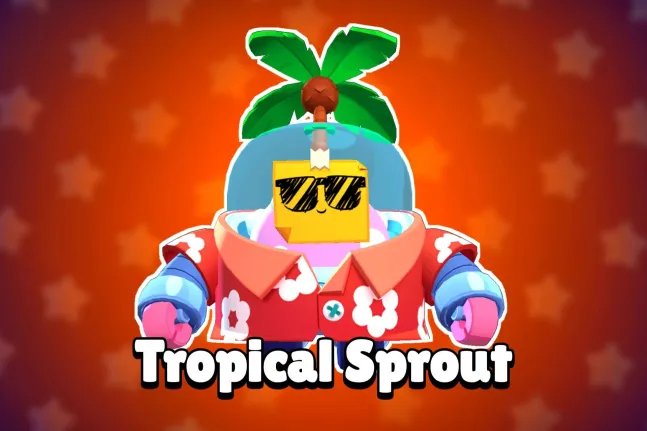
It is worth noting that the Tropical Sprout skin reportedly avoided being affected by the case because the shirt it wears over its body effectively covers the disputed body shape. This has led some community members to speculate that Supercell might adopt a similar approach for the default remodel - for example, by adding some form of clothing or an outer layer to Sprout’s base model. A concept along these lines was shared by a Reddit user, though it remains unofficial and purely speculative at this stage.

8. CONCLUSION - THE OPEN QUESTION
The case illustrates a recurring tension in intellectual property law: where does inspiration end and infringement begin? The French court provided a specific answer based on its interpretation of originality, access, and degree of similarity. It determined that the similarities between Andrea and Sprout were not accidental and that the core shape was protected.
However, as outlined in the controversial issues, the decision rests on subjective assessments of originality and similarity, and on the weight given to different design elements. Other courts, designers, and members of the public may reach different conclusions.
Ultimately, the question of who gets to define the boundary between inspiration and theft is a legal, cultural, and philosophical one. In this instance, the answer was given by the Paris Judicial Court, but the debate itself remains open - and will likely continue as new cases emerge.
Sprout icon design on the rhumbnail was taken from MoonlightBS post via social medias
Share this article