 Boom Beach

INTRODUCTION
If July was a month of contradictions for Boom Beach, August turned those contradictions into something more stark. The headline numbers tell a simple story: more players, same money, fewer downloads. But beneath that surface lies a fascinating dynamic that reveals exactly where this 12-year-old game stands today - and what it needs to watch out for.
THE NUMBERS AT A GLANCE
Total revenue across both platforms for August came in at $1,200,000 - exactly where it was in July. Total downloads, however, fell to 90,000, down from 110,000 the previous month (−18.2%). On the surface, that looks like a step backward. But then you look at the Monthly Active User figures, and the picture flips entirely.
Google Play MAU jumped from 6.6 million in July to 7.6 million in August - a gain of one million active players in a single month (+15.2%). App Store MAU also grew, from roughly 169.7K to 179.6K (+5.8%). So the game added over a million monthly active users while downloads actually dropped by 20,000.
The math here is unusual, and it points to something specific: the growth isn't coming from new installs. It's coming from old players coming back. Returning veterans are firing up the game again, re-installing, and re-engaging. But they aren't spending yet. Android revenue stayed locked at $400,000 for the second month in a row - not a single dollar more despite that million-player surge. iOS revenue also held steady at $800,000. So the audience is soaring, but the revenue line is flat. That's a textbook case of what you might call “overhead growth” - lots of returning or free players who haven't opened their wallets.
THE PLATFORM GAP GETS WIDER
The divide between Android and iOS in Boom Beach has always been pronounced, but August made it even starker. Android accounted for 55.6% of total downloads in August (50,000 out of 90,000), down from 63.6% in July. Yet Android generated just 33.3% of total revenue ($400,000). iOS, with 44.4% of downloads (40,000), brought in 66.7% of the money ($800,000).
What makes this even more telling is that iOS downloads held exactly flat month-over-month at 40,000, while its MAU grew by 5.8% and revenue stayed at $800,000. So iOS players are consistent and predictable - they don't leave in large numbers, they don't rush in, but they pay reliably. Android, by contrast, is a boiling pot: a flood of returning players, but monetisation hasn't caught up.
A 12-YEAR-OLD GAME WITH A MILLION NEW (OLD) FACES
Adding +15% to your monthly active user base in one month is impressive for any game, let alone one that launched over a decade ago. But doing it while downloads are falling and revenue is flat is a signal that deserves attention. The growth is coming from retention and re-engagement, not from new blood. That's a positive sign for the health of the community - players are coming back - but it also raises a question: why aren't they spending?
One possible explanation is that these returning players are lapsed users checking out what's new, but they haven't yet found a reason to open their wallets. Another is that the game's monetisation mechanics are more effective at converting new players than returning ones - and if new installs are shrinking, that conversion funnel is narrowing.
THE CHINESE VERSION: A STEADY CONTRIBUTOR
One piece of the puzzle that hasn't changed is the Chinese version of Boom Beach, available only through the Chinese App Store. Its revenue for August held at $600,000, with downloads at 30,000 - exactly the same as July. The game's peak position among strategy games in China also remained steady at #42 (+6 from July 2026). The last update to the Chinese version was on July 7th, 2026, and there have been no major changes since then.
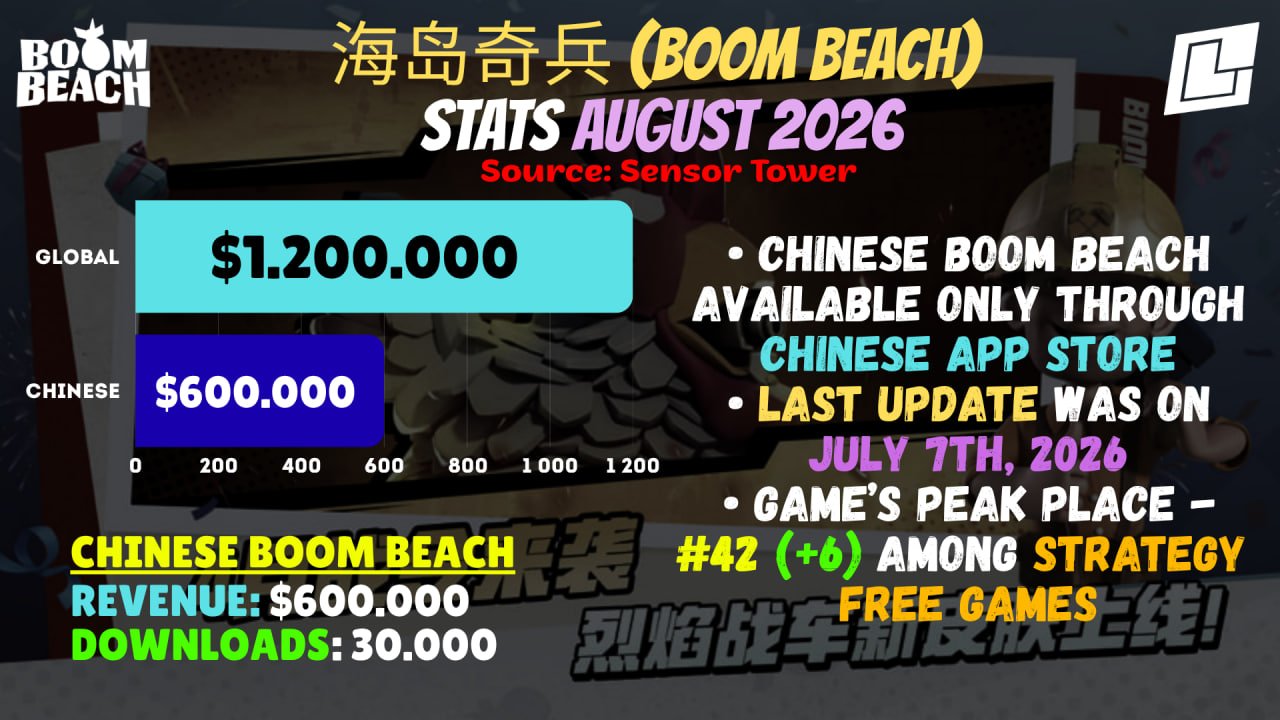
What's notable here is that the Chinese version alone generates $600,000 in revenue - half of the global total - on just 30,000 downloads. That's a staggering efficiency compared to the rest of the world, and it underscores just how important the Chinese market remains for Boom Beach's bottom line. Even with zero month-over-month growth, the Chinese version is a cash engine that the rest of the game can't match on a per-download basis.
CONCLUSION
August 2026 paints a picture of a game that is, in some ways, healthier than ever - a million extra monthly players is nothing to sneer at - but also facing a clear business challenge. The audience is growing through retention and re-engagement, but monetisation isn't keeping pace. Downloads are declining, which means the pool of new players is shrinking, and the game is increasingly reliant on its existing (and returning) user base.
iOS remains the reliable cash cow: steady downloads, steady revenue, steady growth in active users. Android is the wild card: massive audience, massive growth, but revenue that refuses to budge. And the Chinese version continues to punch well above its weight, delivering half of global revenue on a fraction of the downloads.
The question for the months ahead is whether those returning Android players will eventually convert into paying users, or whether Boom Beach will continue to grow its audience without growing its revenue. For now, the game is adding players at an impressive clip - but the business side is waiting for those players to catch up.
Share this article