 Boom Beach

INTRODUCTION
Boom Beach Warships has always been a game of timing, strategy, and adaptation. Every season introduces new possibilities, different metas, and difficult decisions that can determine whether a player reaches the top or falls behind. For most competitors, finishing among the world's best is already an impressive achievement. For a select few, however, the ultimate goal is something even greater: claiming the number one position on the global leaderboard.
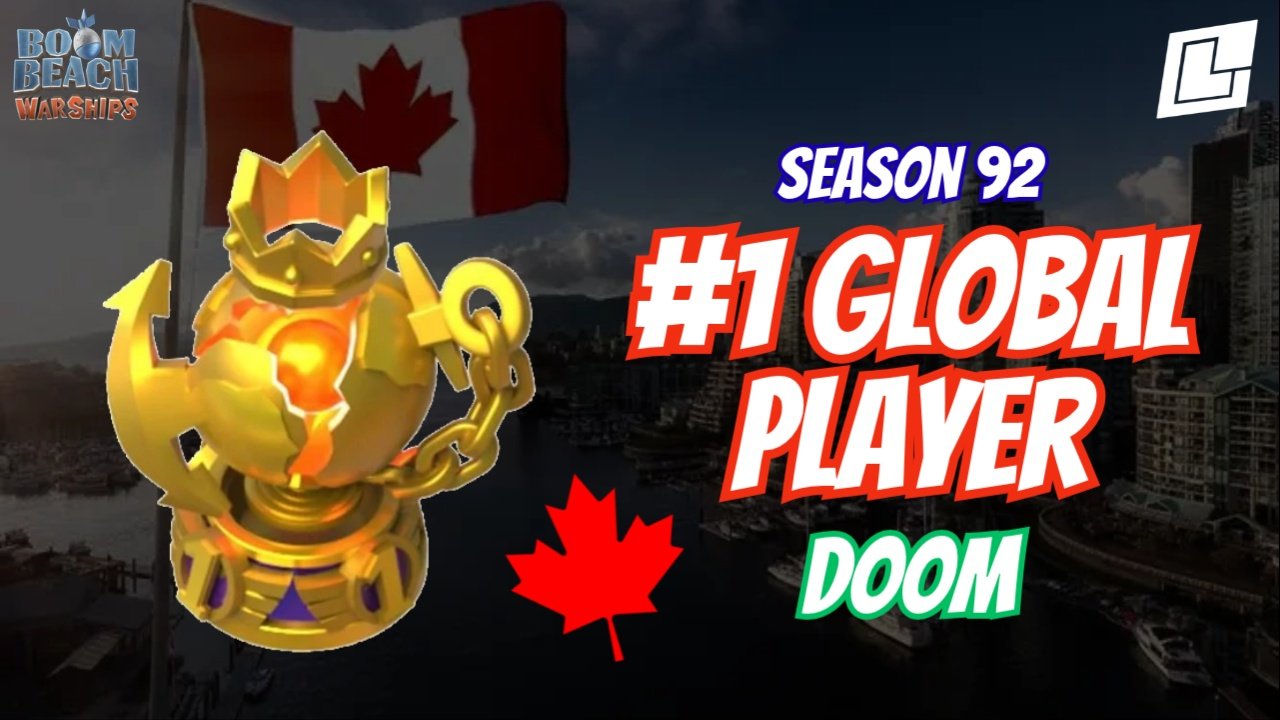
Our guest today is Doom, one of Canada's strongest Warships players and the world's number one player on the leaderboard last season (Season 92). His journey to the top wasn't an overnight success. After discovering Boom Beach around ten years ago, he eventually returned to the game and found himself hooked on Warships during Season 11. Since then, he has spent years learning the mechanics, understanding the evolving metas, and developing the competitive instincts needed to challenge the world's best.
His story also offers a fascinating look at modern Warships competition. Doom explains why the right tech tree can be more important than individual skill, how multiple accounts can provide a competitive advantage, why patience is essential for climbing the leaderboard, and what the developers could do to keep the game fresh. Most importantly, he shares a perspective that every aspiring champion should hear: reaching the top requires considerable time and dedication, but the community surrounding the game can make the journey much easier.
Let's find out what it takes to become the best in the world.
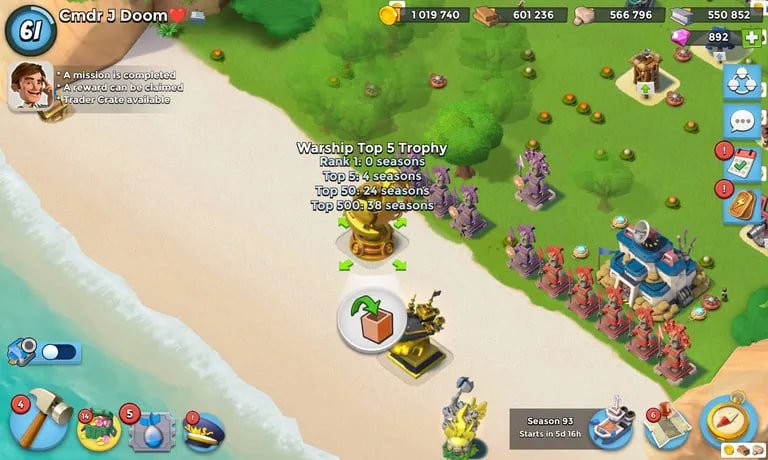
Doom's Thoughts About Warships
From Advertisements to Competitive Obsession
Like many Boom Beach players, Doom's journey began long before Warships existed. Around ten years ago, he discovered the original game through advertisements and decided to give it a try. However, without the seasonal competitive mode that would eventually become his primary passion, his initial experience didn't last forever.
"I got introduced to Boom Beach through the advertisements about 10 years ago, but there was no Warships and eventually I got bored of it. I came back maybe three years later, and Warships Season 11 was the first one I played. I got hooked on it right away."
That return proved to be a turning point. Warships offered something that the original game couldn't quite provide for him: direct competition against other players, where every attack could influence his position and every decision could make a difference.
For someone who has always enjoyed competitive gaming, the mode was a natural fit.
"The thing I like most about Warships is the direct PvP competition, as I've always been a very competitive person in whatever game I play. The general mechanics of the tech tree and the game itself are also satisfying to me."
This combination of competition and strategic progression became the foundation of Doom's interest in Warships. Winning wasn't simply about having a stronger army or attacking quickly. It was about making the right decisions within a system that constantly changed throughout the season.
Interestingly, Doom doesn't necessarily remember individual seasons as clearly as other players might expect. Instead, what stays with him are particular moments: an unexpected meta that nobody anticipated, an exceptionally fast attack, or the first time he reached a new milestone.
Those moments capture something essential about Warships. Even after playing for many seasons, there is always the possibility of discovering something new.
The Road to #1 Global
Finishing first on the global leaderboard is one of the most prestigious achievements in Boom Beach Warships. It requires much more than simply being a good attacker. Players must manage their tech progression, recognize opportunities, maintain their position, and find enough suitable opponents to complete their climb.
For Doom, Season 92 presented a particularly interesting opportunity. The season featured a unique tech tree that prevented players from unlocking every important upgrade. As a result, competitors had to make difficult choices about their progression. Doom recognized that this unusual structure could become a decisive factor in the final leaderboard standings.
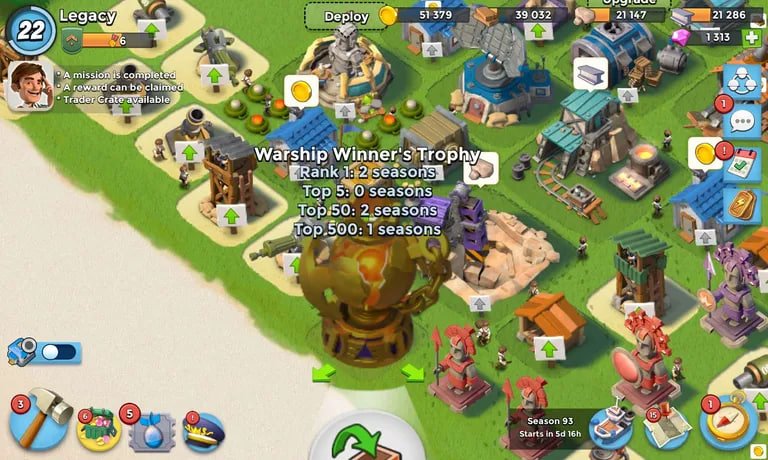
While other competitors eventually stopped pushing, he continued playing.
"To finish first, everything has to go perfectly. This season, all the other competitors stopped early, and because of the unique tech tree, nobody could unlock everything important. I played until the last day and was able to get everything."
That decision proved crucial. By continuing to progress while his competitors had already stopped, Doom gave himself an opportunity to gain an advantage during the final hours of the season.
But unlocking the right upgrades wasn't enough on its own. He also needed opponents to keep climbing.
"Luckily, I found enough opponents to take first in the last three hours of the season, and at that point nobody could catch up."
It was a dramatic conclusion to a season-long competition. With only three hours remaining, Doom found the matches he needed and secured the number one position before anyone could respond.
For Doom, this was the culmination of a long-standing goal. After years of playing Warships and improving his skills, he had finally reached the very top of the global leaderboard.
His achievement highlights an important aspect of Warships that is sometimes overlooked: the leaderboard is a competition not only of skill, but also of timing and opportunity. A player can have an excellent tech tree and perform consistently throughout the season, yet still miss out on the top position if the circumstances don't work in their favor. Conversely, recognizing a late-season opportunity and having the patience to pursue it can make all the difference.
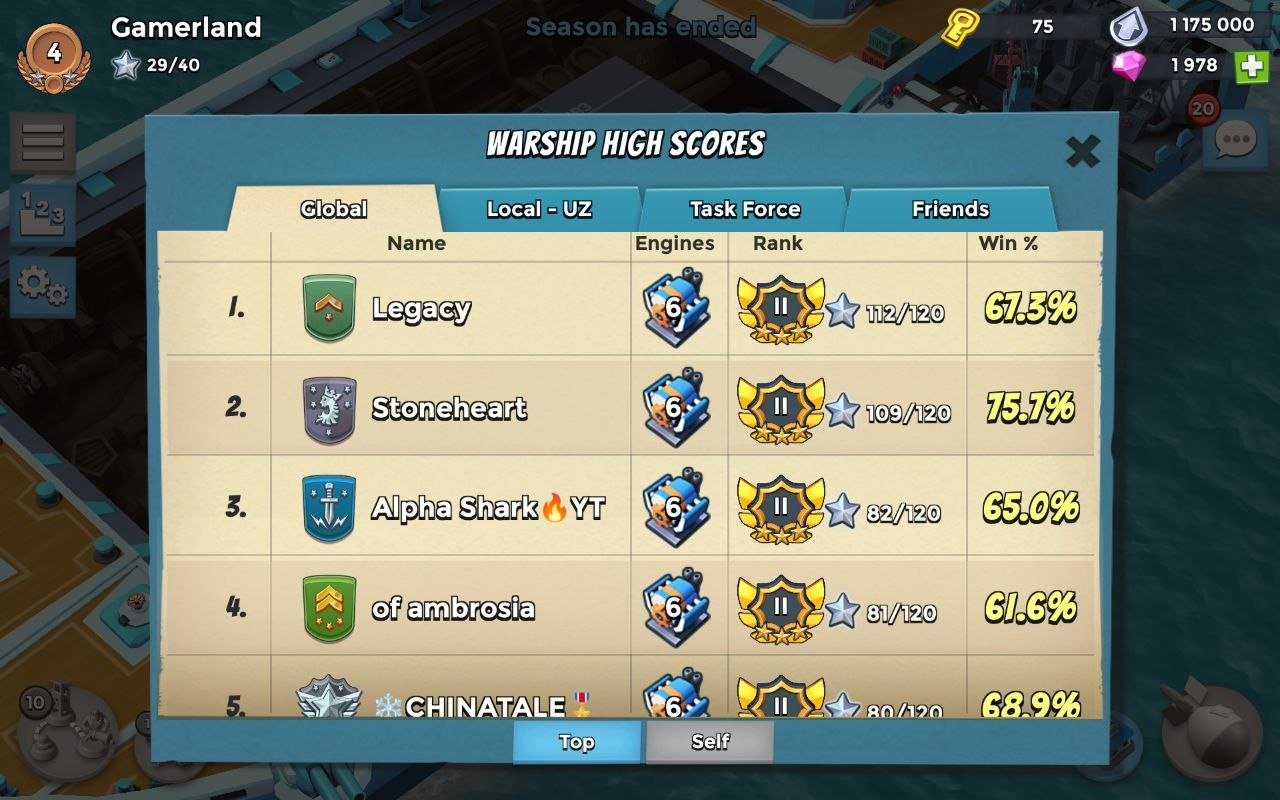
For Doom, everything came together at exactly the right moment. He stayed in the competition until the final hours, made the most of his tech progression, and accomplished what so many Warships players dream of: finishing first in the world.
The Tech Tree: The Real Key to Victory?
One of the most interesting aspects of Doom's competitive philosophy is his view of the relationship between skill and tech tree progression.
Many players naturally assume that the strongest attacker should eventually rise to the top. After all, superior attacking skills should allow a player to overcome opponents with weaker strategies or less experience. However, Doom believes that the reality is more complicated.
"Both tech and skill are important, though I would have to say the right tech is more important."
His reasoning is straightforward. Throughout a season, there are moments when certain upgrades become so powerful that they can dramatically change the outcome of a match.
"There will be certain points of the season where every game is an auto win because you have something that is so much stronger than anything else."
These temporary advantages can define an entire season. Unlocking a powerful troop, ability, or upgrade at the right moment can allow a player to defeat opponents who might otherwise be equally skilled or even better at attacking. Meanwhile, choosing the wrong upgrades can leave a player struggling to keep pace with the competition.
This doesn't mean that skill is irrelevant. A good tech tree won't automatically guarantee success against every opponent, and players still need to understand attack strategies, base layouts, and the strengths and weaknesses of their available units.
Rather, Doom's point is that Warships rewards players who understand the relationship between progression and timing.
The best players don't just ask which upgrade is strongest. They ask when that upgrade will give them the greatest possible advantage.
That distinction is particularly important for anyone trying to climb the global leaderboard. A tech tree that looks impressive early in the season might become less effective later, while a player who patiently saves keys for a critical unlock could suddenly gain the advantage needed to push through several ranks.
Understanding these shifts is a major part of competitive Warships.
Why Doom Plays Multiple Accounts?
Doom is also among the players who use multiple accounts, a strategy that can provide several advantages in a highly competitive environment. Although maintaining additional accounts requires more time, he believes they can serve useful purposes beyond simply having more opportunities to play.
One advantage is the ability to explore different tech tree paths. Rather than committing every account to the same progression, a player can experiment with different strategies and observe how they perform throughout a season.
This can be particularly useful when trying to understand an unfamiliar meta or preparing content for other players. Another benefit is practice. A secondary account can provide an opportunity to test attacks and experiment with strategies before attempting them on a main account, where a mistake might have more significant consequences for a leaderboard push.
"There can be multiple advantages to playing multiple accounts, from playing different tech paths for content to being able to practice attacks on a small account before playing the main account."
Doom also mentions another potential use: targeting competitors during a leaderboard push.
"There can also be advantages to sniping competitors if playing for top spots on the leaderboard. However, it does take a lot more time as opposed to only playing one account."
This approach illustrates how seriously some players approach the competitive side of Warships. At the highest levels, the game can extend beyond individual matches into a broader exercise in planning, preparation, and understanding the behavior of other competitors.
Nevertheless, multiple accounts aren't a requirement for success. They are an additional tool that can help experienced players manage their preparation and explore different strategies.
The trade-off is obvious: more accounts mean more time spent playing, progressing, and maintaining them. For players who simply want to enjoy the game casually, that commitment might not be worthwhile. For someone pursuing the highest leaderboard positions, however, the additional flexibility can be valuable.
What Makes a Truly Great Warships Player?
Trophies and leaderboard positions are the most visible ways to measure success in Warships. However, Doom believes that determining who the strongest players really are requires looking beyond a single result. He evaluates players according to three main criteria.
1. Consistently achieving high ranks
A single excellent season can be impressive, but repeated success provides stronger evidence of a player's ability. Different seasons favor different strategies, and a player who consistently performs well demonstrates an ability to adapt to changing conditions.
2. Gaining ranks when the tech is equal
Doom considers the final stages of a season particularly revealing. When competitors have access to similar technologies, the advantage provided by progression becomes smaller, and individual skill becomes more important.
"If they can gain rank at the end of the season when tech is equal and skill matters much more."
This is an especially useful distinction because it helps separate players who rely heavily on a powerful tech advantage from those who can consistently outperform similarly equipped opponents.
3. Performance in head-to-head matches
Finally, Doom looks at direct confrontations between strong players. These encounters can provide valuable evidence of individual ability because both competitors are operating at a high level and are often familiar with the same strategies and metas.
Taken together, these criteria offer a more complete picture of a player's strength than a leaderboard position alone. A player who consistently reaches high ranks, performs well when tech is equal, and wins direct confrontations against other elite competitors has a strong case for being considered one of the best. For aspiring competitive players, Doom's approach also provides a useful lesson: focus on becoming a consistently strong player rather than chasing a single impressive result.
The Problem of Win Trading
Competitive integrity is an important issue in any game with a global leaderboard, and Warships is no exception. Doom describes a system that some high-ranking players refer to as a "milk group", in which players allegedly coordinate matches to manipulate leaderboard results.
According to his account, participants use a private group to arrange favorable matchups. Players communicate when they begin searching for an opponent and when they find one, allowing members to identify one another and coordinate who should win. He also alleges that some of these arranged victories involve small payments.
"At the top, it's very predictable who you will match, and normally 50% or more of the top 50 is in this group."
These figures and descriptions reflect Doom's personal account of the situation rather than independently verified statistics. Nevertheless, his explanation illustrates why coordinated match manipulation can be so damaging to a competitive leaderboard. In a game where individual victories and losses influence ranking progress, deliberately arranged results can give certain players advantages that legitimate competitors cannot reliably reproduce. The problem becomes even more serious when players are risking their position near the end of a season. A legitimate competitor might have to win several difficult matches to advance, while someone receiving coordinated victories could potentially progress much more easily.
However, Doom believes the situation has improved.
"Thanks to some very welcome changes by the developers, the strength of this group has decreased drastically, and it's now more possible than ever to beat them."
He points to the previous season as evidence, noting that, in his assessment, everyone in the top five was a legitimate competitor. This is an encouraging development from the perspective of fair competition.
For a player who has spent years working toward the number one position, the opportunity to compete on a more level playing field is particularly important. No amount of strategy or attacking ability can fully compensate for a system in which results are routinely manipulated.
Can New Players Challenge the Veterans?
With years of experience behind him, Doom is well positioned to assess whether newcomers can compete with established Warships veterans.
His answer is encouraging, although he emphasizes that individual ability makes a considerable difference.
"Personally, it took me a very long time to get good at the game - about 15–20 seasons. However, I've seen many people play at a top 50–100 level after just one or two seasons."
The contrast is striking. Doom needed considerable time to develop his competitive skills, but some players can reach an impressive level much faster. This suggests that experience alone doesn't determine how quickly someone improves. Natural ability, dedication, strategic understanding, and the willingness to learn from mistakes can all influence the process.
For new players, this is good news. There is no fixed number of seasons they must complete before they can become competitive. However, they shouldn't expect immediate success simply because they understand the basic mechanics.
Warships requires players to develop several skills simultaneously: learning how to attack efficiently, understanding tech tree progression, recognizing powerful metas, and knowing when to push for ranks and when to wait. The most successful newcomers are likely to be those who actively study the game rather than simply repeating the same strategies without understanding why they work.
Doom's own journey shows that improvement is possible over time, while the rapid progress of some newcomers demonstrates that there is no single path to mastery.
The Biggest Mistake Beginners Make
If Doom had to identify the most common mistake made by inexperienced players, his answer would be clear: trying to win all the time.
At first glance, this might sound strange. After all, isn't winning the entire point of a competitive game? The problem is that Warships doesn't always reward constant aggression. Players sometimes unlock powerful technologies that give them a temporary advantage over their opponents. During these periods, pushing aggressively can be highly effective. But when that advantage disappears, continuing to force progress can become frustrating and inefficient. Doom explains:
"By far the most common mistake of beginners is thinking they are supposed to win all the time to have a good season. They will unlock all sorts of stupid things to try to stay on top for as long as possible, but this almost never works."
Instead, he recommends patience.
"The top players push with a good tech advantage and then just wait for the next good tech advantage to push whenever that may be, and don't get bothered by losses in between."
Sometimes, the smartest decision is to stop pushing.
A player who has reached a favorable position with a strong tech tree might benefit from preserving that advantage rather than spending resources on upgrades that provide little long-term value. Similarly, someone struggling against a dominant meta might be better off waiting for the next important unlock than repeatedly attempting to overcome an unfavorable matchup.
For beginners, Doom's advice can be summarized in three principles:
- Understand your tech advantage. Recognize when your current upgrades give you a realistic opportunity to climb.
- Spend keys strategically. Avoid unlocking upgrades simply because they seem attractive in the moment. Consider how they fit into your overall progression.
- Don't panic over losses. A difficult stretch doesn't necessarily mean your season is going badly. Sometimes, patience is more valuable than another immediate victory.
In Warships, knowing when not to push can be just as important as knowing how to win.
Is Warships Better Than It Used to Be?
Having played Warships across numerous seasons, Doom has witnessed the mode's evolution firsthand. His overall assessment is positive.
"Warships is definitely trending in the right direction compared to a couple of years ago."
However, he still believes there are opportunities to make the mode more enjoyable, particularly for long-time players who have experienced many different seasonal formats. One of his main suggestions is to bring back older seasons.
Rather than relying exclusively on new seasonal designs, Doom would like to see occasional throwback seasons that revisit some of the mode's earlier experiences.
"The main thing I would like to see is some more throwback seasons - maybe once a year have a redo of one of the first 10 or 20 seasons."
Such a system could appeal to both veteran players and those who joined the game later.
For veterans, it would provide an opportunity to revisit familiar strategies and relive memorable metas. For newer players, it would offer a chance to experience seasonal designs they might otherwise only hear about from older members of the community. Doom also highlights two units that he believes can sometimes create balance problems: Laser Rangers and Critter Launchers.
"Keeping the Laser Ranger and Critter Launcher out of some seasons every so often, as these two things can be very unbalanced at times."
A seasonal mode becomes less interesting when the same strategies repeatedly define the most effective approach. Different tech trees, unusual restrictions, and returning historical formats can encourage players to experiment and reward adaptability. For someone who enjoys discovering unexpected metas, these changes could make future seasons particularly exciting.
What Comes Next After Becoming #1 Global?
After achieving the ultimate competitive goal, what motivates a player to continue? For Doom, the answer is a new challenge. Rather than focusing exclusively on repeating his leaderboard success, he wants to expand his presence in the Warships community by developing his YouTube channel.
"Now my main goal is to grow my YouTube channel, starting with livestreams next season and hopefully more videos."
Competing at the highest level requires considerable concentration and time. Creating content, on the other hand, offers an opportunity to share knowledge, interact with viewers, and explore different aspects of the game. Doom is also interested in experimenting with challenges that aren't necessarily focused on leaderboard competition.
"Maybe some more unique challenges that aren't as competitive or serious as competing on the leaderboard."
This could provide a different way to enjoy Warships while remaining connected to the community.
For viewers, it could mean learning from one of the game's strongest players, watching his decision-making in real time, and seeing strategies tested in situations that go beyond conventional competitive play. It also gives Doom an opportunity to help others improve, extending the value of his experience beyond his own accounts.
The Future of Warships: More Than Just Another Tech Tree
When we asked to imagine the future of Warships, Doom doesn't limit himself to small balance changes or familiar seasonal formats.
He sees opportunities to experiment with the fundamental structure of the mode itself.
One possibility is to introduce more seasons that revisit older designs, as he previously suggested. Another is to introduce entirely new mechanics that change how players approach progression.
This could introduce another layer of strategic customization, allowing players to develop different approaches depending on their chosen upgrades and overall tech tree.
His other idea is even more ambitious:
"Completely redesigning the tech tree. Maybe one season it's like a pyramid instead of the standard shape."
A pyramid-shaped progression system could fundamentally change how players plan their upgrades. Rather than following the familiar structure, they might have to navigate a different set of choices and prioritize their resources in new ways. Such a change could make preparation more challenging while rewarding players who are willing to experiment rather than relying on established habits.
Doom acknowledges that the future ultimately depends on the developers.
"I don't know what the developers will do in the future, but, as I said before, some redux of past seasons would be nice while also doing more unique things with the tech tree in other seasons."
The common theme throughout his suggestions is experimentation.
Warships doesn't necessarily need to abandon its core mechanics to remain interesting. It can preserve what players enjoy while occasionally introducing new systems, revisiting old ideas, and challenging the assumptions that have developed around the current meta. For a game built around seasonal progression, that willingness to experiment could be essential to keeping the experience fresh.
Doom's Formula for Becoming the Best
After years of experience and one season at the very top, Doom's advice for aspiring champions is surprisingly straightforward. He doesn't claim that becoming the best is an impossible task, nor does he suggest that success requires some secret technique that only a handful of players can understand.
Instead, he emphasizes the time commitment and the value of learning from others.
"I wouldn't say it's too difficult, but very time-consuming. The biggest help is having a good community around you to learn from."
This is an important distinction. Warships can be complicated, particularly when players are trying to understand unfamiliar tech trees or adapt to a rapidly changing meta. Learning entirely through trial and error can take a long time.
A strong community can accelerate that process. Experienced players can explain why certain upgrades are effective, demonstrate attack strategies, and help newcomers recognize mistakes they might otherwise repeat for multiple seasons. Doom also believes the community is one of the game's greatest strengths.
"Luckily, this entire game has a great tight-knit community that's always willing to help, and it's one of the best things about Boom Beach as a whole."
His words offer a fitting conclusion to a story built around individual achievement.
Although the global leaderboard ranks players against one another, improving at Warships doesn't have to be a solitary experience. Sharing knowledge, learning from stronger competitors, and helping others understand the game can benefit the entire community. Doom's own journey required years of experience, strategic thinking, and persistence. But his advice suggests that aspiring players don't need to figure everything out alone.
Sometimes, the fastest way to become stronger is to learn from those who have already made the mistakes you're about to make.
CONCLUSION
Doom's journey from a casual Boom Beach player to the world's number one Warships competitor is a story of persistence, adaptation, and recognizing opportunities when they appear.
His success last season wasn't simply the result of winning more battles than everyone else. It involved understanding an unusual tech tree, continuing to progress when other competitors stopped, and finding the right opponents during the final hours of the season. His experience also challenges several common assumptions about competitive Warships.
Being the strongest attacker doesn't automatically guarantee the highest ranking. A powerful tech advantage can sometimes matter more than individual skill, while patience can be more valuable than constantly trying to win. Multiple accounts can offer useful strategic opportunities, but they also demand additional time. And even experienced players can continue finding new ways to enjoy the game after reaching their biggest competitive goals. Perhaps the most encouraging part of Doom's story is that he doesn't view becoming the best as an unattainable dream. He sees it as a demanding objective that requires dedication, time, and the willingness to learn.
His advice to newcomers is equally valuable: don't rush every decision, don't become discouraged by losses, and don't underestimate the importance of the people around you. As Doom prepares to focus more on YouTube, livestreaming, and creative challenges, his next chapter promises to be different from the intense leaderboard competition that brought him to the top.
One thing, however, remains unchanged: Warships is a game of constant adaptation, and there will always be another strategy to discover, another season to master, and another challenge to overcome.
For Doom, reaching number one was the realization of a long-standing ambition. Now, the challenge is to build on that achievement - and perhaps help the next generation of Warships champions find their own path to the top.
Share this article