 Hay Day
INTRODUCTION
This is a graph of the 5 most profitable mobile farm games for 2026:
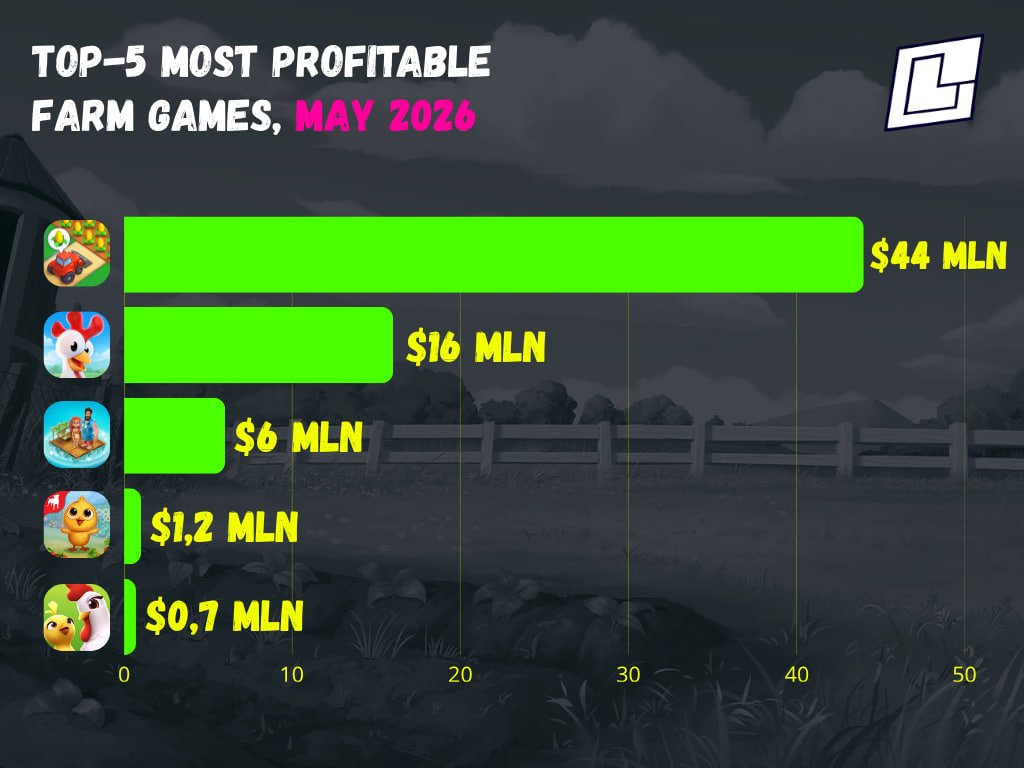
Currently, only two games hold very high positions: Township and Hay Day. Both games entered the global market in 2012. And their statistics are simply astounding: TownShip earns a whopping $44 million and regularly receives 6 million new downloads. Hay Day from Supercell holds a confident second place with a monthly revenue of $16 million.
In this article, we'll take a closer look at how, after 14 years, the game continues to receive regular updates, how it still earns over tens of millions of dollars, look at statistics from previous years, and examine what players spend so much money on within the game itself.
HAY DAY KEY FIGURES
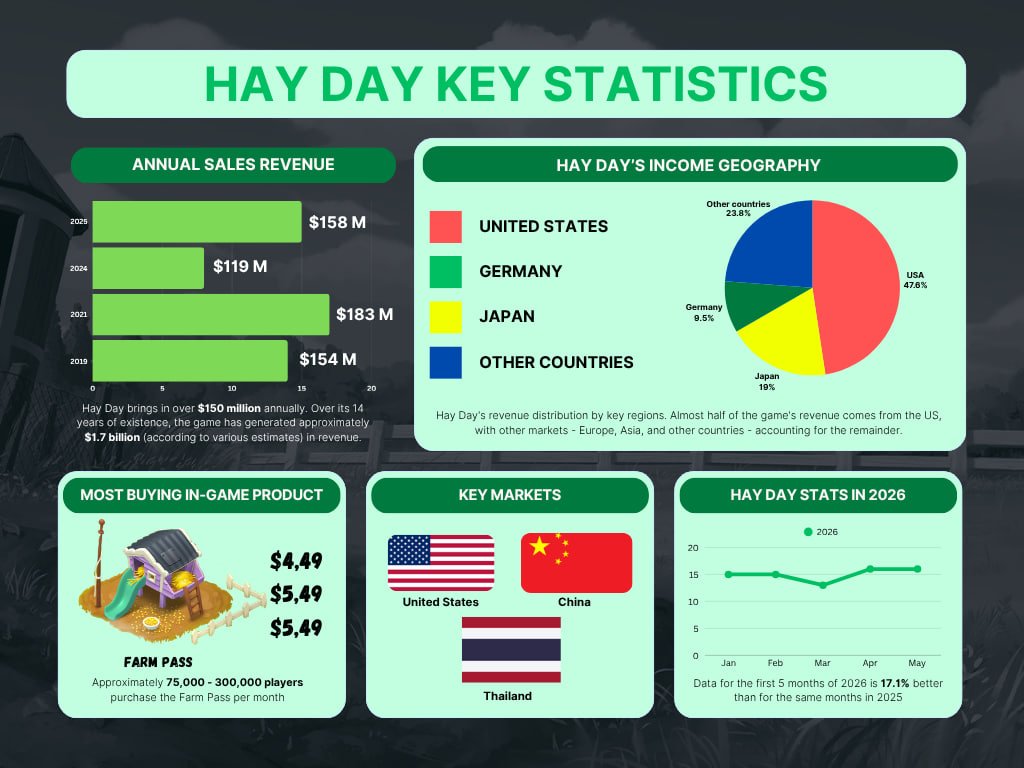
Source: According to analytics platform Sensor Tower, Hay Day sales range from €2.49 to €47.99 per item. The most popular markets are the US, China, and Thailand. The game is available in over 20 languages, including Arabic, Vietnamese, and Simplified Chinese. Revenue typically peaks on the first of the month. For example, on April 1, 2026, the game earned $1,087,660. This was due to the release of the new Farm Pass season.
HISTORY: HOW IT ALL BEGAN
Hay Day was Supercell's first game, released two months before Clash of Clans. It essentially paved the way for the future mobile empire. Before its release, the company had tried its luck on Facebook - the cancelled Gunshine project failed to take off, and the studio was on the brink. It was then that the team took the decisive step toward the mobile market with a farming concept adapted to finger touch.
The initial market was occupied by Zynga with FarmVille, ported from Facebook to mobile devices. However, this port didn't take into account the specifics of touch controls: players had to click on small elements, mimicking mouse behavior. Supercell took a different approach. As designer Camilla Avellar, who worked on the game, recalled: "Our actions were initially oriented toward touch controls and were designed to fit in the hand, which differentiated us from games that simulated mouse behavior".
This approach worked. The sheer tactility of the process of planting and harvesting proved incredibly enjoyable. As longtime project lead Stephan Demirdjian noted, "Discovering that planting and harvesting is such a real and enjoyable experience was a key design decision. While it seems small, it had a huge impact back then".
KEY FIGURES: REVENUE AND AUDIENCE
Let's get to the main point: how much does this farm actually earn?
Total Revenue
According to analytics platform Appmagic, as of spring 2026, Hay Day generated approximately $1.4 billion in lifetime revenue. Other sources put the figure higher: over $2 billion. This discrepancy is due to the fact that analytics platforms estimate Android's share differently and do not account for direct purchases through Supercell's web store.
Current Monthly Revenue
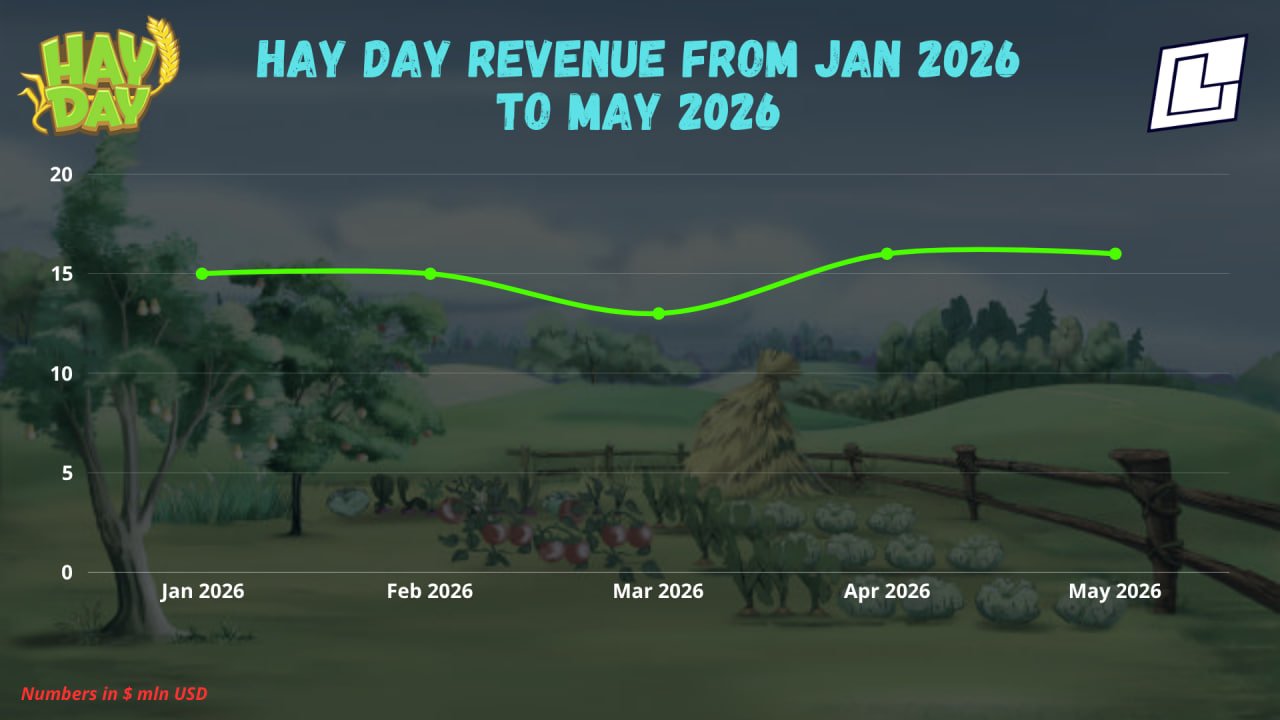
According to analytics platform Sensor Tower, in April 2026, Hay Day generated approximately $16 million in revenue. The peak day was April 1st, when the game earned $1,087,660. In May 2026, Hay Day also made $16 million & 1,7 million downloads.
To put this into weekly terms: according to Sensor Tower data for the Austrian market for Q3 2025, weekly Hay Day revenue fluctuated between $44,000 and $50,000. Naturally, these figures are significantly higher globally.
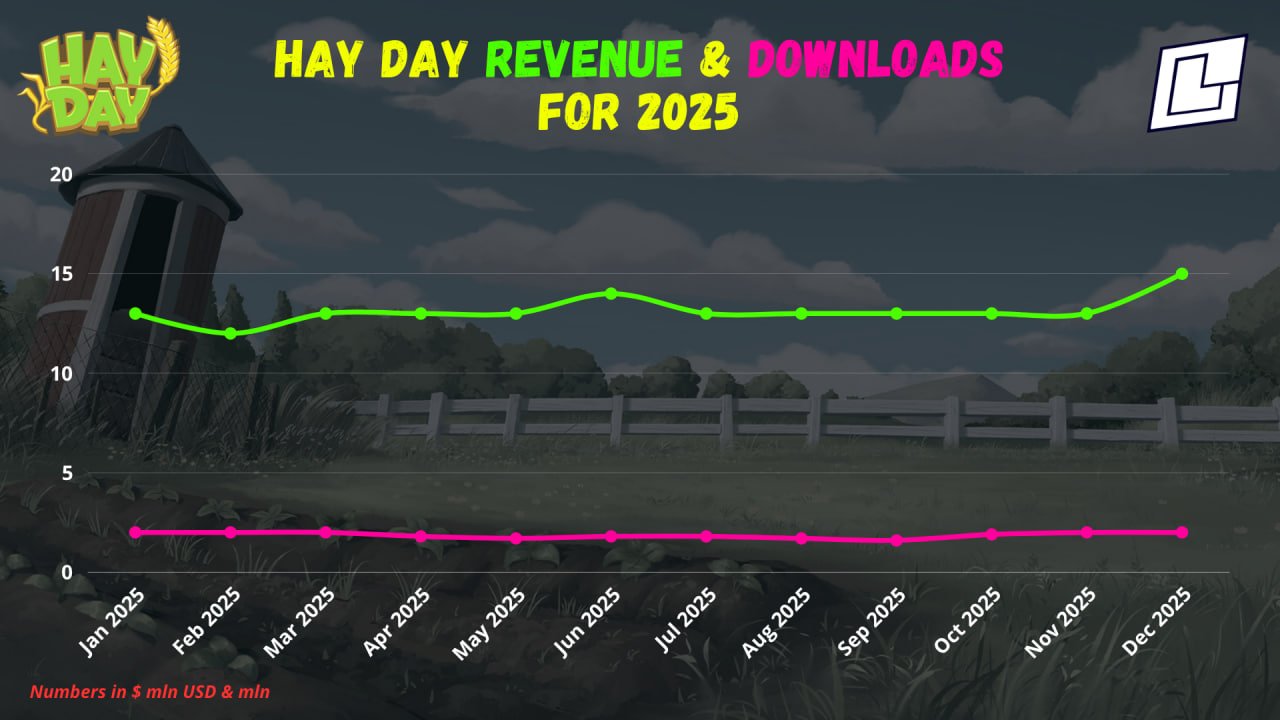
Hay Day Revenue Trends for 2025
Below you can see the revenue and download numbers. Overall, the game has earned $158 million and been downloaded 22.3 million times. Speaking of downloads, Hay Day has been downloaded over 367 million times since its inception!
MAU and Downloads
According to analytics platform Appmagic, Hay Day is downloaded approximately 3 million times monthly, with an average monthly audience (MAU) of ~15 million players.
Speaking at the PGC London 2025 conference, Hay Day General Manager Maya Hofree revealed a valuable internal metric: after years of decline, the active player base has begun to grow. She noted, "We have a truly loyal, stable player base, which has even been growing over the past few years. The game is still relevant and maintains its viral growth. If we want to offer players the best experience, we must continue to grow".
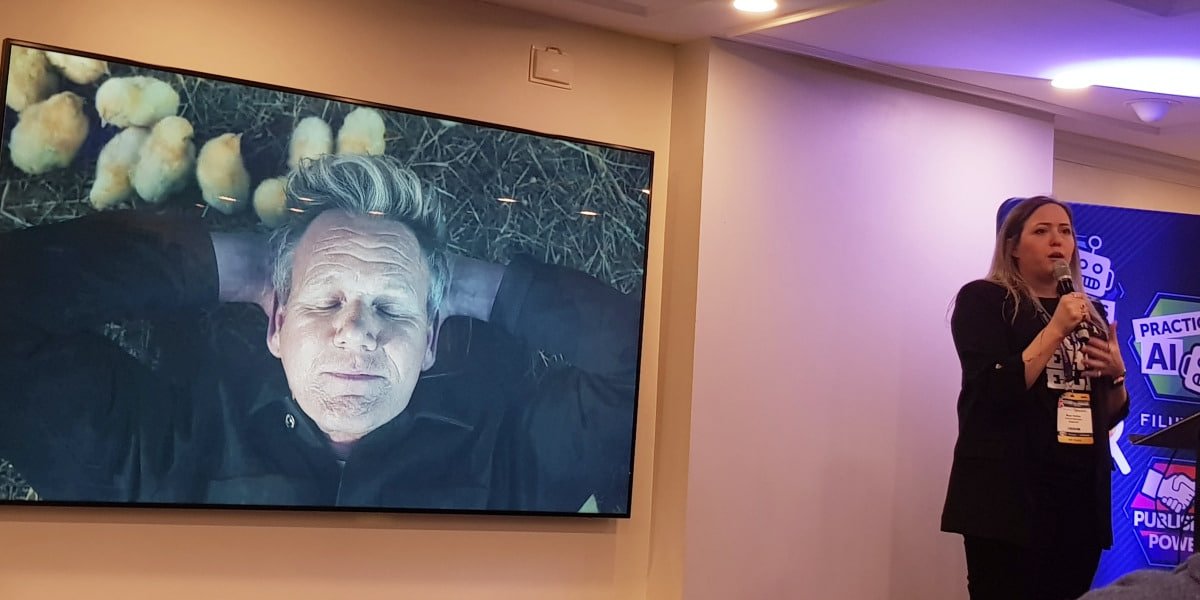
In the same presentation, she confirmed that if forced to choose between retaining the existing audience and attracting new ones, she would unhesitatingly choose retention as her top priority.
SECRETS OF SUCCESS: WHY THE GAME STILL ALIVES
One of the most common mistakes when analyzing live-ops games is reducing everything to a single factor. In fact, five fundamental factors underlie Hay Day's success:
1. Finger-friendly design and tactile magic
The decision to ditch the main character's avatar was no accident. In an interview with GamesIndustry.biz, Demirdjian explained that the team deliberately moved away from the player as a character: the player already controls the entire farm, and an avatar would only create unnecessary visual noise.
The main draw is the tactile pleasure of basic actions: planting, harvesting, and petting animals. Over the years, no competitor has been able to surpass Hay Day in this simple yet critical sensation. It's not just the animation, but also the response time, vibration (on mobile devices where it's supported), and sound. Every microelement is calibrated to trigger a dopamine response.
In an era of hyper-casual games and big-name blockbusters, Hay Day remains an oasis of calm where you can stop by for five minutes between tasks and still have the same experience as in 2012.
2. "Players First, Growth Later" - a retention philosophy
Hofree has publicly acknowledged that the team prioritizes retaining current players over aggressively acquiring new ones. In a world where most mobile games lose 90% of their audience in the first 30 days, this approach is pure gold.
Instead of chasing virality at any cost, Hay Day adds expansions every year that don't disrupt the existing experience, but rather provide a smooth entry point for newcomers and depth for veterans. A classic example is the introduction of Valley and the expansion of neighborhoods, which added a social component without imposing mandatory multiplayer mechanics.
3. Farm Pass and the Live Events System
If there was one reason Hay Day consistently earns $15-16 million per month after 12 years, it would be the Farm Pass.
According to analytics platform Sensor Tower, the launch of Farm Pass in December 2020 saw revenue grow 62% month-on-month. The game soared from $8.7 million to $14.1 million. March 2021 was the best month since July 2017, earning $15.6 million.
As of April 2026, the Farm Pass structure has become significantly more complex. The current version includes three parallel paths with different rewards, and additional weekly quests have been added for the most active players. The full Farm Pass currently costs $11.99.
In addition to the Farm Pass, the game features daily and weekly live events with temporary bonuses. These are divided into:
1 - Global Events – lasting 2-5 days, rewards are unlocked as all players collectively achieve goals;
2 - Local events change daily and provide small bonuses to production, sales, or experience.
This system creates stable "engagement anchors": players know that if they log in on a certain day of the week, they will receive a specific bonus.
4. A Team of 50: A Small Army with High Efficiency
In 2025, at the PGC London conference, M. Hofree revealed the inner workings of the Hay Day team. The team is 50 people, divided into three sub-sells (small autonomous groups), each responsible for a specific part of the game: content, the event system, and economic balance. There are also eight leads, who facilitate communication between the sub-sells and related departments.
Note: each of these 50 people directly impacts 15 million players. This is one of the main reasons why Hay Day remains agile after 12 years - the team is small enough to make decisions quickly and large enough to support a high-quality live-ops pipeline.
5. Continuous A/B testing and a data-driven approach
The Hay Day team doesn't rely on intuition. According to the Live Ops Manager job posting, which opened in early 2026, a live ops specialist must, among other things, conduct A/B and multivariate tests to optimize retention, engagement, and monetization.
Every new mechanic and every store offer is first tested on a small sample of players. If metrics don't improve, the feature is either refined or rolled back. This approach minimizes the risk of "killing the game" with a bad update.
MONETIZATION: HOW HAY DAY WORKS
Now let's take a closer look at where those millions come from.
Farm Pass
As mentioned earlier, the Farm Pass is the main driver. However, it's important to understand how it works. According to the Hay Day Wiki, the Farm Pass works in-game as follows:
• Unlocks at level 11;
• Valid for the entire calendar month;
• 3 Daily Quests;
• 3 Weekly Quests;
• In the standard version, you need to earn 600 points to complete the basic path;
• The extended paths (Party Pass and Festival Pass) require 900 and 1150 points, respectively.
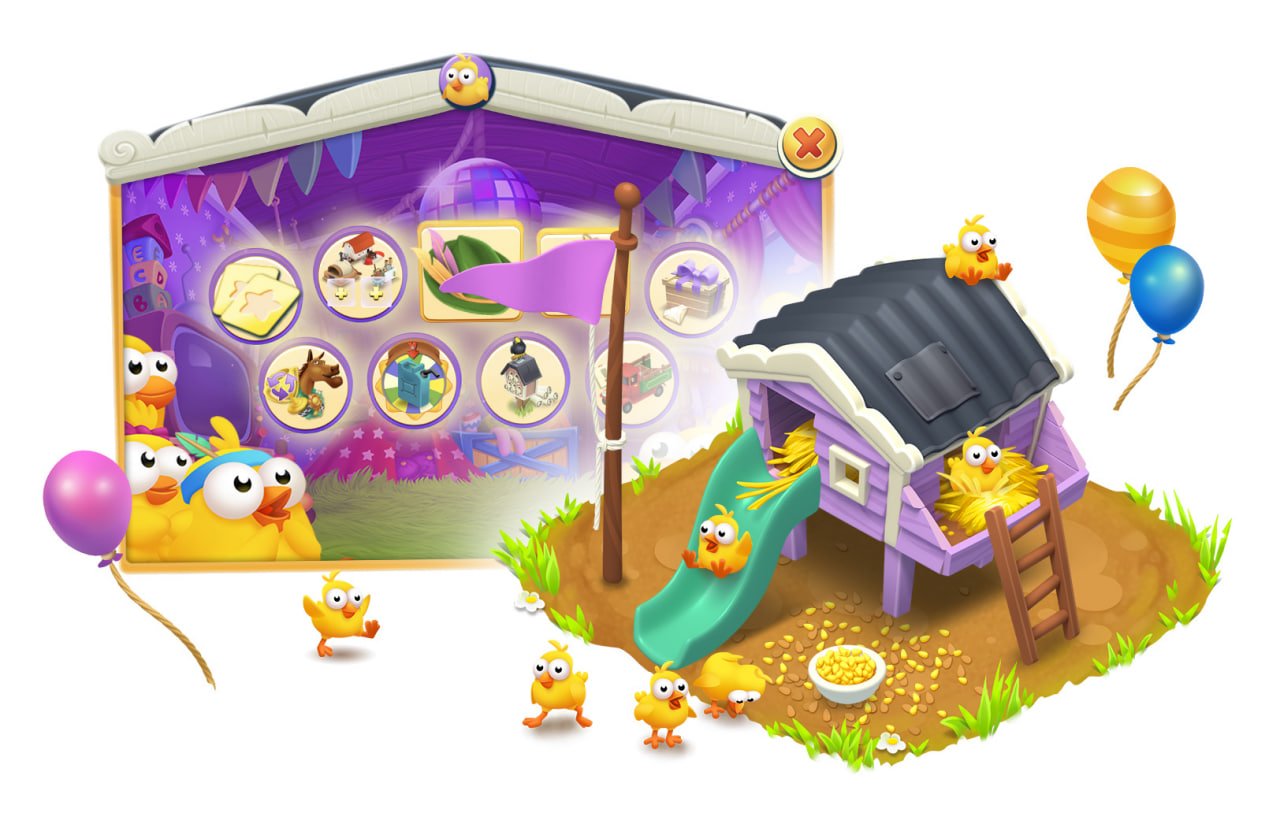
If you want to complete the extended paths, you can purchase up to 3 additional weekly quests for 10 units of in-game currency each. Therefore, a Free-to-Play player can only obtain the basic set of rewards from the bottom of the path.
Monetization nuances that the reports don't cover
Hay Day doesn't have any hard pay-to-win elements that break the economy. A paying player can't buy invulnerability or unlimited resources. Paying for money will reward you with either a speed boost, exclusive aesthetics (decorations), or additional tasks, which still take time to complete.
WHY IS HAY DAY AN IP ASSET?
One of the most insightful characteristics of Hay Day was expressed in a Gamigion research note in 2026: "Hay Day isn't just a mobile game. It's a real IP asset." What does this mean?
First, Supercell has already attempted to expand the IP: in 2020, it released Hay Day Pop, a puzzle game set in the same universe. The game didn't take off and was shut down, but the very fact that it attempted this demonstrates that the company views Hay Day as a long-term brand, not a one-off project. As of spring 2026, the company is again experimenting with expanding Hay Day, this time in partnership with Playabit.
Second, the monetization potential of such an audience is enormous: 15 million MAUs is a highly loyal target group willing to purchase Farm Pass for years to come. If Supercell can convert at least 5-10% of this audience into paying players through Farm Pass and additional offers, a stable income of $10-20 million per month is guaranteed for years to come.
Thirdly, the value of such an asset for advertising partnerships and cross-promotion with other Supercell games is obvious: Hay Day players are the ideal audience for softer casual games.
RISKS AND CHALLENGES
However, not everything is rosy. Even a colossus like Hay Day has its weaknesses.
1. Mechanics become outdated for a new audience
Players who started in 2012 are now adults with families and jobs. Their tastes have changed. Newcomers born after Hay Day's release expect a different level of graphics, gameplay solutions, and social mechanics.
The team is aware of this challenge. As Demirdjian noted, in the early years, development focused on new content, but over time, they had to shift to innovation and social features: "Over time, as players began to master content faster than we could release it, we began to think about new social layers, tasks, and interaction mechanics."
2. Competition from Township and new games
Township continues to widen its revenue lead (by some estimates, $44 million versus Hay Day's $16 million in May 2026, see picture 1). Township combines farming mechanics with city simulation, providing more hooks for different types of players. Hay Day is more conservative - this is both its strength and its vulnerability.
CONCLUSION - WHY HAY DAY CONTINUES TO “PRINT” MONEY
If we condense all of the above into a single formula for Hay Day's success, it would look like this:
Sustainable Revenue = (Haptic Core × Loyal Audience) + (Farm Pass × Live Ops)
14 years ago, Supercell bet on mobile exclusivity, honed the haptic experience to perfection, and avoided the pay-to-win trap. This created a foundation - a core of millions of players who return years later.
Then, in 2020, the team added Farm Pass - and experienced explosive revenue growth that has remained stable ever since.
The active audience is growing, the 50-person team remains flexible enough for rapid iteration, and Supercell continues to view Hay Day as a long-term IP asset, not just a game on the fringes.
Based on the current situation, the game could become one of the company's top three highest-grossing games in the coming months!
SOURCES
1. Sensor Tower – Global revenue data for Hay Day in April 2026 (~$16 million), peak daily earnings (April 1, 2026 - $1,087,660), in-app purchase structure (€2.49–€47.99), revenue geography (US, Germany, UK, Canada)
2. Appmagic – Estimated lifetime gross revenue for Hay Day (~$1.4 billion), monthly downloads (~3 million), monthly active users (MAU) (~15 million)
3. Pocket Gamer (PGC London 2025) – Interview with Hay Day General Manager Maya Hofree: team size (50 people), active player base growth, prioritising retention over new user acquisition.
5. Handwiki – Historical data: total gross revenue exceeded $1.2 billion by the end of 2023, Hay Day was among the top‑4 highest‑grossing mobile games in 2013.
6. GamesIndustry.biz – Interview with long‑time Hay Day lead Stephan Demirdjian on design decisions (no avatar, tactile gameplay core), the game’s evolution from content to social features.
Share this article