
 Squad Busters
INTRODUCTION
On October 30, 2025, the digital storefront of Supercell grew quieter by one title. Squad Busters vanished from it without fanfare. On that day, all in-game purchasing and creator support features were switched off. Development was officially terminated - the game became history.
Just eighteen months prior, that history was being written as a deafening triumph. May 2024: after five and a half years of anticipation and scrapped beta projects, Supercell’s new global release exploded onto the charts. It was promoted by Hollywood stars and a marketing blitz that saturated the internet. The result was a record-shattering 19 million downloads in its first month - more than all of Supercell’s other flagship titles combined. Revenue soared to $23 million. It seemed a new perennial hit was born.
But the triumph proved to be a mirage. The revenue curve didn’t rise; it plunged almost vertically toward zero, losing 99.31% by the time the servers went dark. How did the loudest premiere in the company’s history become its most rapid and spectacular failure?
Through a detailed analysis of the game’s month-by-month performance data, we will piece together the forensic evidence of this crash. This is not a mere post-mortem of declining revenue, but an investigation into what broke the seemingly flawless hit-making machine.
CHAPTER 1. A RECORD START WITH A HIDDEN PROBLEM
1.1. What is Squad Busters?
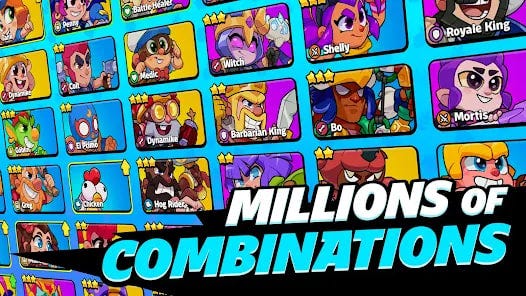
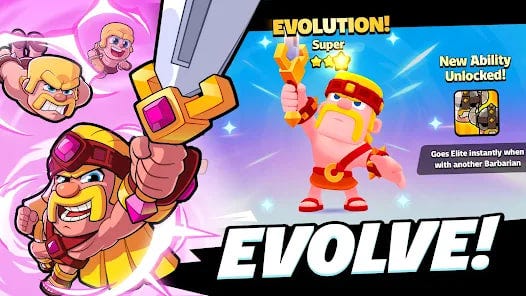
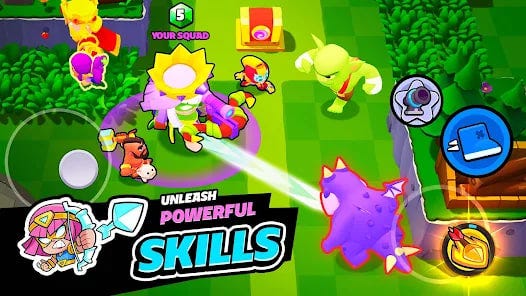
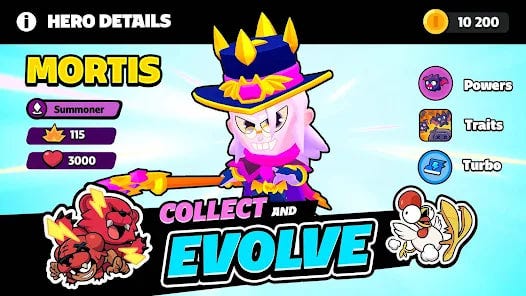
This section is for those who have not played Squad Busters and do not know what it is about, or have not heard of it at all. What was Squad Busters? Squad Busters was a mobile action game released globally by Supercell in May 2024. It was the studio’s first new global release in six years and later became the first Supercell game to be shut down after a global launch. The core idea was to bring together popular characters from all Supercell universes - like Clash of Clans, Brawl Stars, and Hay Day - into one chaotic, party-style experience.
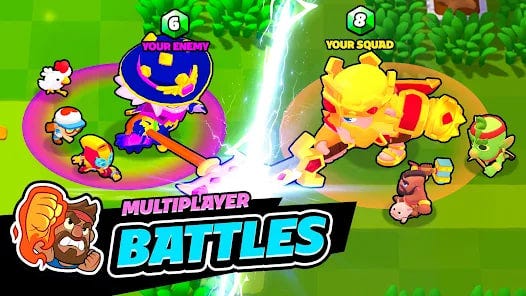
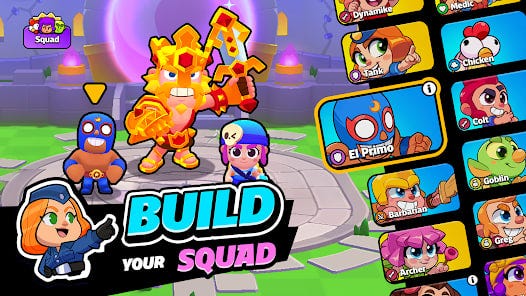
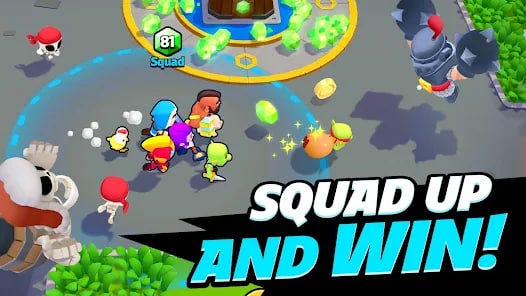
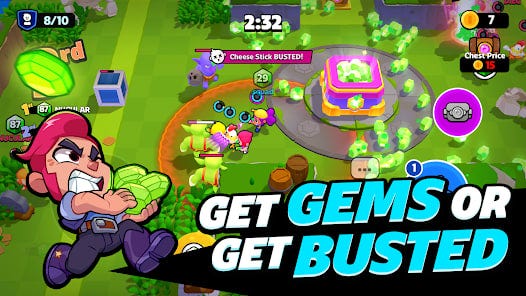
The Core Gameplay Loop (The Gist): Players formed a squad of characters and entered short, 4-minute PvPvE matches. The goal was to farm gems by defeating creatures and other players on a map. During a match, you could open chests to randomly add more characters to your growing swarm, creating massive, chaotic battles. The game combined elements from MOBAs, battle royales, and roguelikes, but simplified them for a casual audience.
The Initial Appeal & The Hook: For players, the main attraction was the “Supercell crossover” - the fun of collecting and battling with familiar characters from different games. For Supercell, it was a high-stakes experiment. They skipped their traditional lengthy soft-launch phase, betting instead on a massive, Hollywood-style global marketing campaign to immediately capture a huge audience. While the launch was explosively successful in terms of downloads, the game ultimately failed to retain players due to repetitive gameplay and a lack of long-term depth.

Now let’s move on to tha main topic of the article - statistics of this game. Let’s break down the first explosive month of Squad Busters, from its soft launch in late April to the end of June 2024. The numbers tell a story of massive hype, but if you look closer, you can already see the cracks that would eventually sink the ship.
1.2. The Soft Launch: A Promising Test Run
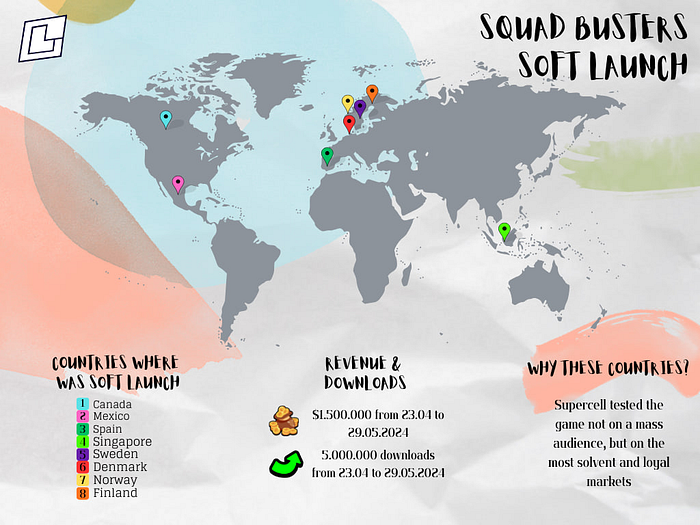
Before the global fanfare, Supercell ran a focused, five-week test in just eight countries. The selection was strategic: a mix of high-spending Western markets (Canada, Scandinavia), key Spanish-speaking regions (Spain, Mexico), and the crucial Asian tech hub of Singapore. On paper, the results were promising. In this limited run, the game pulled in a solid $1.5 million in revenue and was downloaded over 5 million times, becoming Supercell’s fastest game to hit that milestone.
This test served a specific purpose. It wasn’t about attracting the masses, but about checking the game’s core stability and monetization potential in a controlled, “greenhouse” environment - essentially, with Supercell’s most loyal and likely-to-spend players.
And that was the trap. The strong initial numbers created a deceptive sense of confidence. The logic seemed flawless: “If it works this well in these diverse, profitable markets, a global launch will be a guaranteed hit”. The forecast based on this data predicted a 6x revenue jump for the first global week, which later proved almost eerily accurate.
However, this brief rehearsal failed to answer the critical long-term questions: Would a casual player in Indonesia or Brazil stick with the game? Was the core gameplay loop engaging enough to justify spending? The soft launch, by design, tested the game’s peak potential under ideal conditions but completely missed diagnosing its fundamental weaknesses for a global, mainstream audience. It was a perfect rehearsal for a show that would flop on opening night for reasons the actors never got to practice.
This sets the stage for the central paradox of Squad Busters’ launch: phenomenal reach coupled with shockingly weak monetization, which became painfully clear the moment the game went global.
1.3. The Global Explosion & A Weird Split
On May 29th, 2024, the game blew up. I mean, it really blew up. In its first global week, it made a crazy $9.16 million. Combined with the soft launch, that’s over $10.66 million in just over a month.
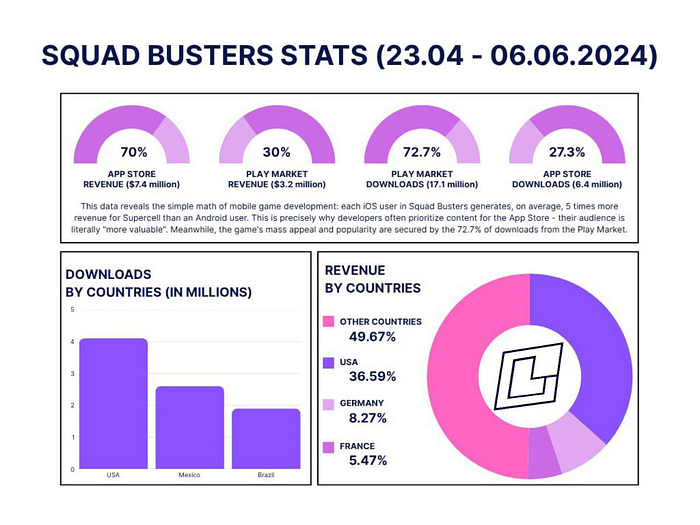
Now, check this out - the story for downloads was completely flipped. Over 72% of the installs came from Android. So, way more people downloaded it on Android, but the people on iPhone spent way, way more. How much more? On average, each iOS user was five times more valuable than an Android user. That’s a huge gap. It tells me the game was really resonating with a premium, Apple-device crowd, but failing to convince the massive Android audience to open their wallets.
The global launch propelled Squad Busters into the stratosphere. The first week was one of the most profitable in the game’s entire history.
Revenue Breakdown📈
Between May 29 and June 6, Squad Busters generated a staggering $9.16 million from in-app purchases. Total earnings reached $10.66 million in just over a month.
Platform Disparity📲
A classic mobile market dynamic emerged. The App Store contributed 70% of the revenue ($7.4 million), while Google Play accounted for 30% ($3.2 million). The situation was reversed for downloads: 72.7% of installs (~17.1 million) came from Android, while only 27.3% (~6.4 million) came from iOS. This meant that, on average, each iOS user was five times more valuable than an Android user.
Market Leadership🥇
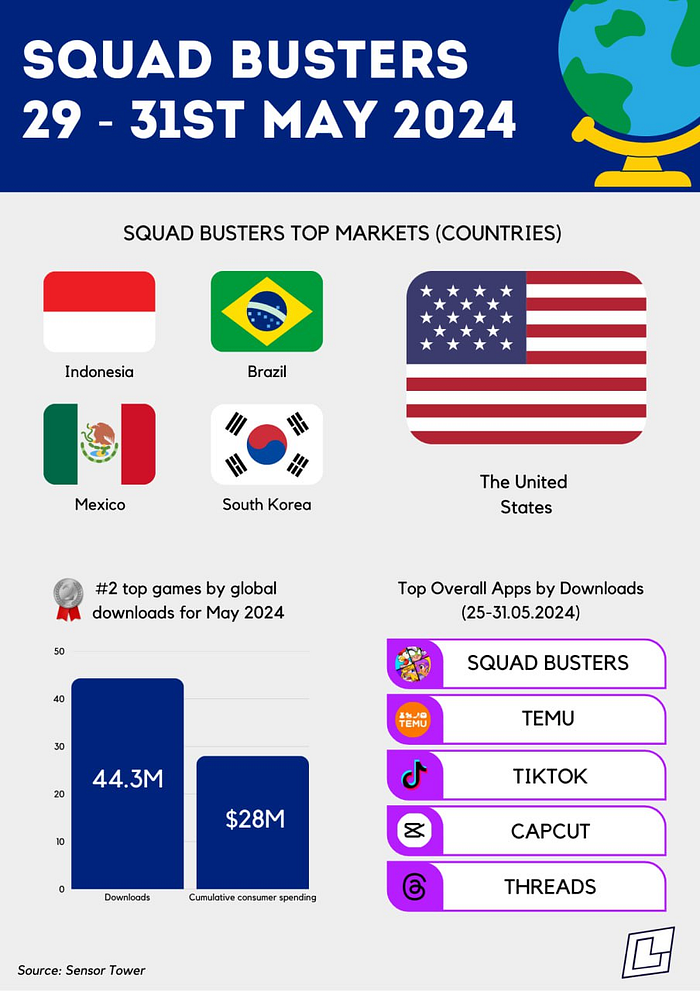
The success wasn’t just financial; it was also competitive. From May 25 to 31, 2024, Squad Busters topped the chart of the most downloaded apps in the United States, outperforming giants like TEMU, TikTok, CapCut, and Threads. It also secured the position of the #2 top game by global downloads for the entire month of May.
Geographic Reach🌍
⏬Top Countries by Downloads: USA, Indonesia, Brazil, Mexico, and South Korea
💰Top Countries by Revenue: The United States was the undisputed leader ($3.9 million), followed by Germany ($882.000) and France ($583.600).
1.4. June 2024: The Peak That Showed the Truth
June was the absolute peak. This is where the story gets really clear, and honestly, a bit shocking.
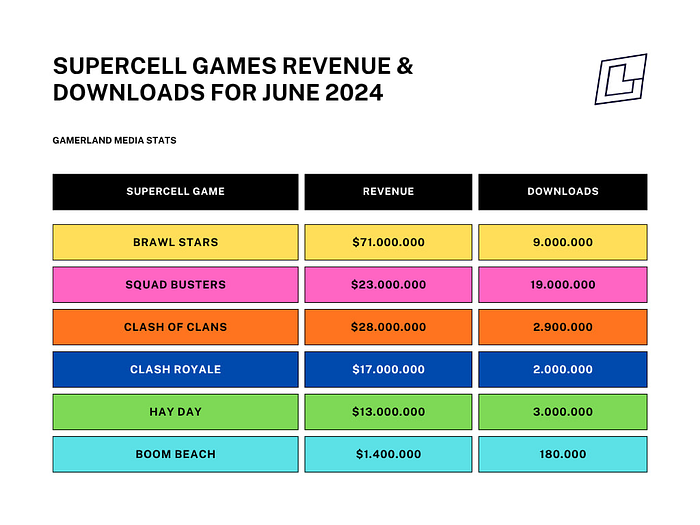
The download number is insane: 19 million installs in one month. Let me put that in perspective for a second. In that same month, all of Supercell’s other famous games - Clash of Clans, Brawl Stars, Clash Royale, Hay Day, Boom Beach - combined had just over 17 million downloads. Let that sink in. Squad Busters, by itself, was bigger than the rest of Supercell’s lineup. The marketing, the crossover characters - it all worked perfectly to get people in the door.
So, with all those people, the revenue must have been world-beating too, right? Well… not exactly.
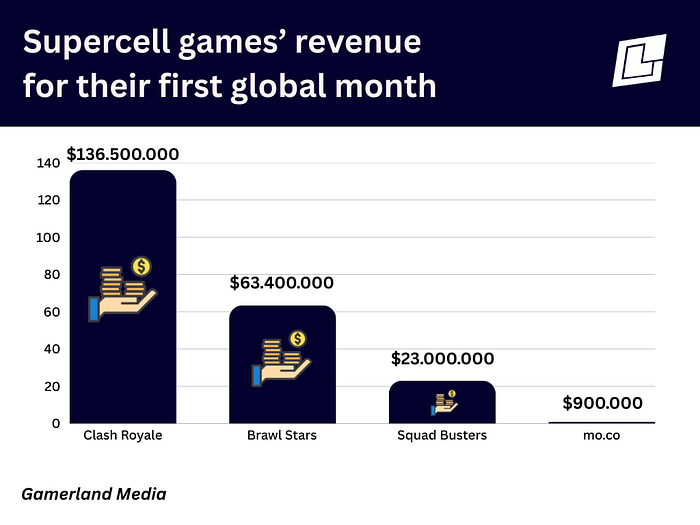
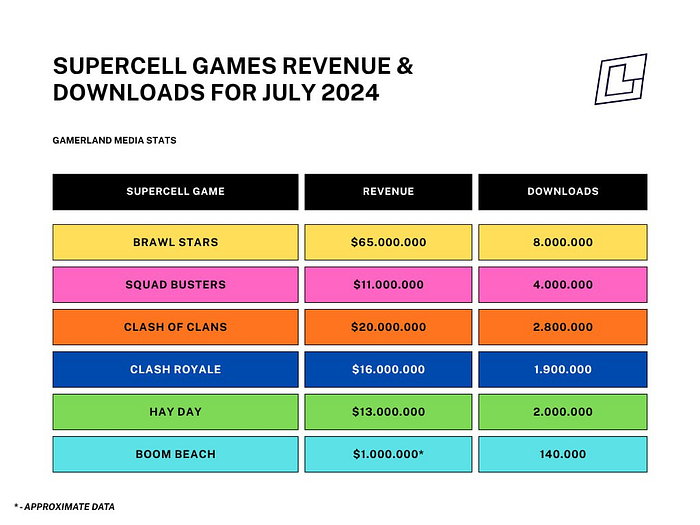
It made $23 million. A huge number for almost anyone, but for Supercell’s newest baby, it was only good enough for third place inside the company that month, behind Clash of Clans ($28M) and the monster Brawl Stars ($71M).
1.5. ARPU Was Terrible
This is the most important part of the whole analysis. To understand why this was a failure, you can’t just look at the total money. You have to look at the money per player.
I did the math on what’s called “Average Revenue Per User” or ARPU. It’s simple: total revenue divided by total downloads. For Squad Busters (June 2024): $23 million/19 million users = about $1.21 per person.
Now, let’s compare it to Supercell’s past hits (based on common industry estimates for their first months):
• Brawl Stars (2018): Made about $6.34 per user.
• Clash Royale (2016): Made a staggering $9.10 per user.
Do you see the problem? Even if those old estimates aren’t perfect, the gap is enormous. Squad Busters was making 5 to 8 times less money from each player than Supercell’s previous blockbusters did when they launched. Moving away from the topic, the next game from Supercell, mo.co (2025), will make only $0.3 per user.
So, what’s the bottom line of Chapter 1?
Squad Busters won the battle for attention in a historic way. But it completely lost the battle for monetization from day one. It brought in a huge crowd that, for whatever reason, just didn’t feel like spending much. In the mobile game world, if players don’t start paying early, they usually never will. The steep, painful drop that followed was almost a mathematical certainty.
CHAPTER 2. HOW UPDATES AND COLLABORATIONS COULDN’T STOP THE BLEEDING
If Chapter 1 showed us the crack in the foundation, Chapter 2 is the story of the entire building collapsing. The summer of 2024 wasn’t just a slump for Squad Busters; it was a full-blown catastrophe that no amount of new content, not even giant transforming robots, could fix. Let’s track the month-by-month unraveling.
2.1. July 2024: Update That Couldn’t Stop a 52% Crash
The party ended abruptly. After the hype-fueled peak of June, July hit like a bucket of ice water.
The Numbers: Revenue was halved, dropping 52.2% from $23 million to $11 million. Player interest evaporated even faster, with downloads collapsing by 79%, from 19 million to just 4 million.
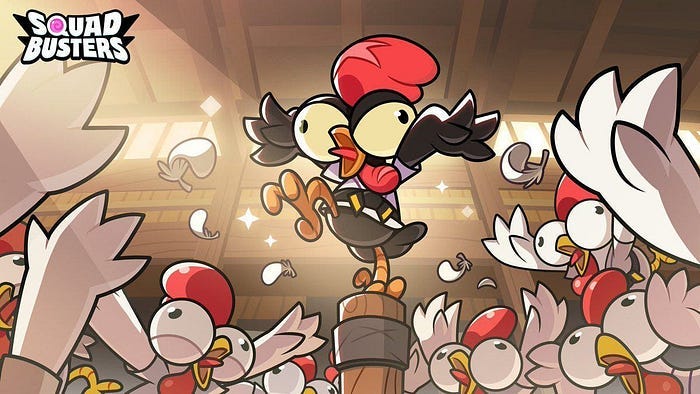
The Update: Supercell tried to fight back with a summer-themed update: a new Gem Pass skin (“Pool Party” Hog Rider), a community event (More chickens in battles = more rewards players get), a new character (“Bandit”), and Twitch rewards.
The Analysis: This is where we saw the core problem. These updates added stuff, but they didn’t fix the game. Players weren’t just leaving because they were bored of the old content; they were leaving because the core gameplay loop wasn’t fun enough to stick around for new content. For context, other Supercell games saw mild seasonal dips of around 10%. Squad Busters’ 52% crash was in a league of its own - a clear signal of a failing product, not a slow market.
2.2. How powerful was Squad Busters’ marketing?
While the game was bleeding players in July, a different story was unfolding behind the scenes - one of a marketing campaign of almost unimaginable scale. Looking at the numbers, it’s clear Supercell was trying to buy its way back to the top.
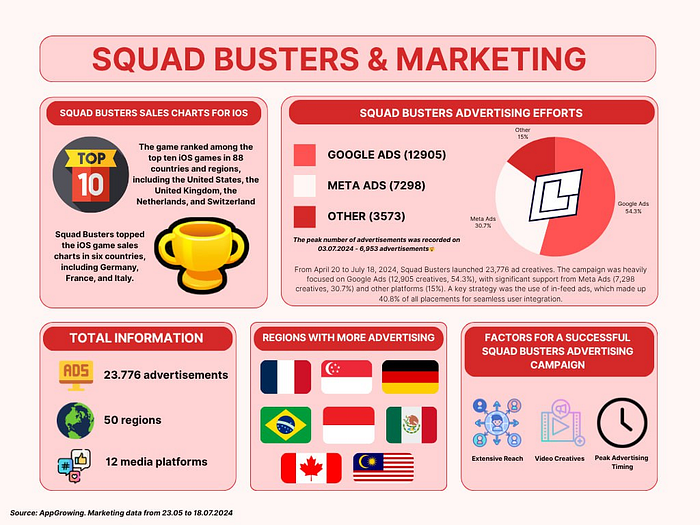
From late April to mid-July 2024, the team unleashed a staggering 23,776 unique ad creatives for Squad Busters. To put that in perspective: that’s creating over 250 new ads every single day for nearly three months. The campaign was a precision strike:
• 54.3% of the force (12,905 ads) went through Google Ads to capture the vast Android market.
• Another 30.7% (7,298 creatives) blanketed Meta’s platforms (Facebook, Instagram), aiming for users in their social feeds.
• The effort peaked on July 3, 2024, with a record 6,953 ads running simultaneously - a final, massive push to cement the game’s place.
And for a brief moment, it worked. This blitz propelled Squad Busters into the top 10 highest-grossing iOS games in 88 countries, and it even hit the #1 spot in six countries, including Germany, France, and Italy.
But here’s the brutal truth this data reveals: the marketing was solving the wrong problem. The campaign was a masterpiece of awareness and user acquisition. It was designed to answer the question, “How do we get millions of people to install our game?”
The tragic flaw of Squad Busters was that it failed to answer the next, more important question: “How do we make them stay and play?”. You can’t advertise your way out of a broken core gameplay loop. The millions spent on 23,776 ads were ultimately funneling new players into a leaky bucket. It was the most expensive way possible to discover that your product simply isn’t good enough.
2.3. August 2024: Major New Content, Same Old Trajectory
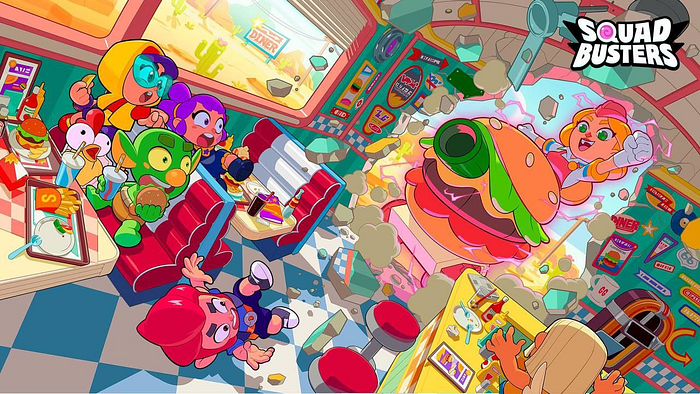
With the team back from holiday, Supercell delivered its first big “SQUAD UPdate” on August 10th. It was substantial: a new Lava world, three new characters (Archer, Miner, Leon), new events, and system tweaks.
The Numbers: The result? A continued decline. Revenue fell another 27%, from $11 million to approximately $8 million. Downloads followed, dropping an estimated 35% to around 2.5–2.6 million.
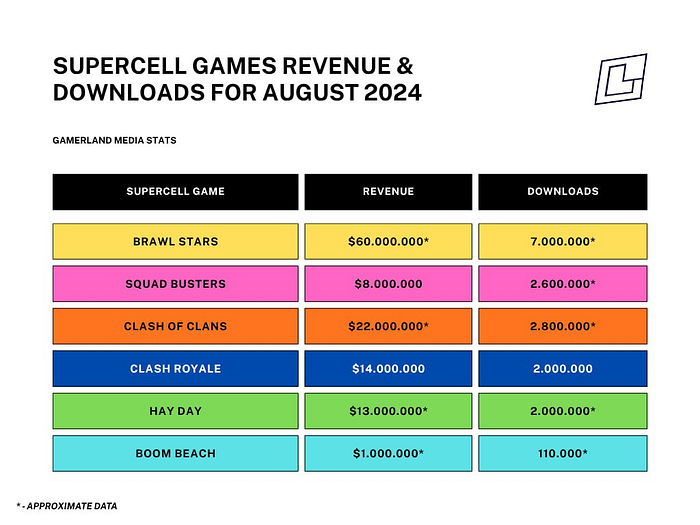
The Analysis: This was a critical moment. A major content update failed to reverse the trend. It proved that the issue wasn’t a lack of content at launch; it was that the fundamental gameplay couldn’t support player retention. People tried the new stuff and still walked away.
2.4. September 2024: The Transformers Collab - A Last, Loud Gasp
In a move of desperation, Supercell pulled out a classic industry playbook move: a blockbuster collaboration. They brought in the Transformers.
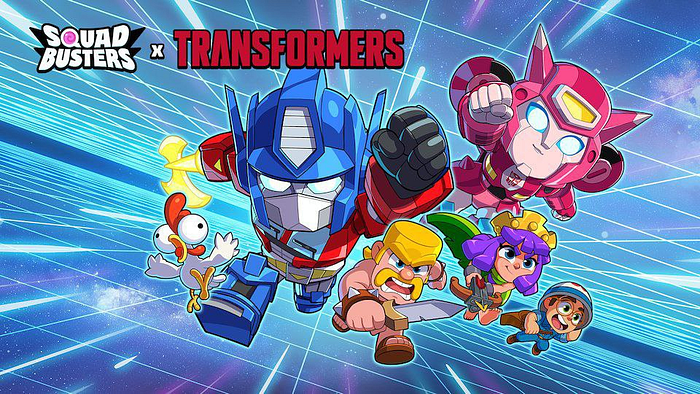
The Numbers: The result was a devastating verdict. While revenue decline slowed slightly to 12.5% (down to ~$7 million), downloads nosedived 57.7% to just 1.1 million. This was the last month downloads ever stayed above 1 million.
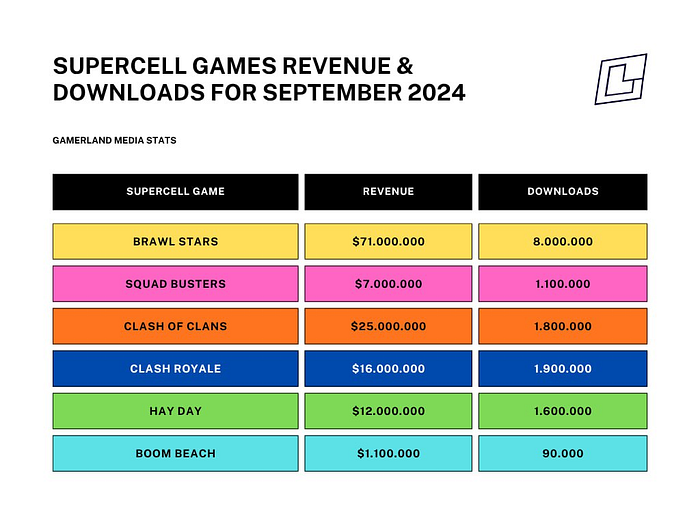
The Analysis: This collaboration was a final test of market interest. If a brand as huge as Transformers couldn’t attract new players, nothing would. It showed the game had lost all organic pull and discovery. The player base was now a tiny, shrinking core.
2.5. October-November 2024: The Slow, Relentless Fade
Alright, after the Transformers hype fizzled out in September, the last quarter of 2024 felt… quiet. Too quiet. Let’s see what the numbers say.
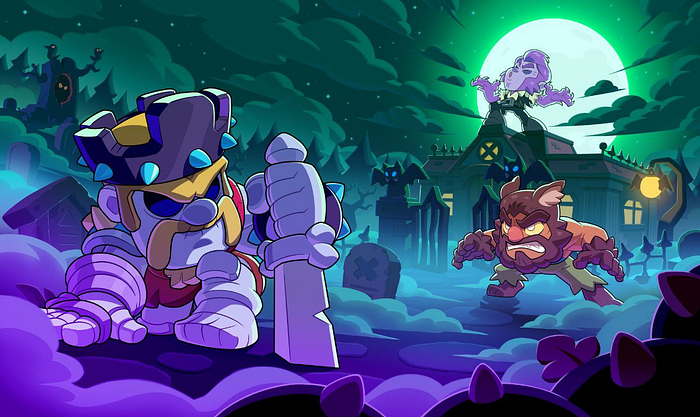
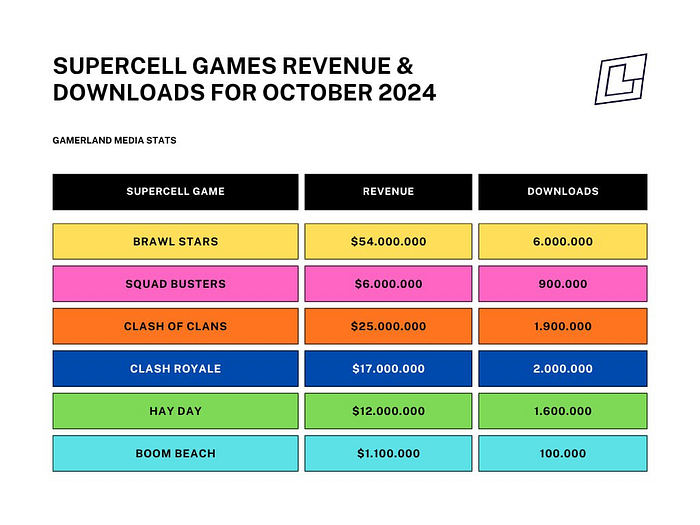
So, October rolls around. Remember that crazy $23 million from June? Well, it’s a distant memory now. Revenue for the month settled at $6 million. That’s still a drop of about 14% from September, by the way. Downloads were at 900,000. Not zero, but not exactly setting the charts on fire either. The most telling part? Look at the competition within Supercell. Brawl Stars was pulling in $54 million that same month. Our game was making nine times less than the company’s top earner. Let that sink in for a second. October also brought us new Squad UPdate with new Spooky World and 3 new characters - Ruffs, Poco & Frank
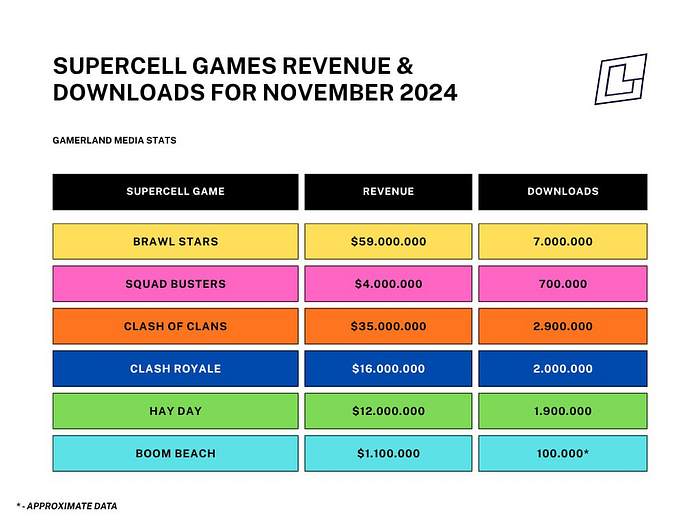
Then came November. It was a slow fade. Revenue took another hit, falling to $4 million. Downloads dipped to 700,000.
And here’s where it gets really sobering. Squad Busters’ monthly revenue fell below Hay Day, a farming simulator that’s been around for over a decade. Let’s be honest, Hay Day! It was now just barely keeping ahead of Boom Beach, a game that’s practically in maintenance mode. This wasn’t just a slump; it was the game officially dropping out of Supercell’s major league.
The takeaway? No big crashes, no dramatic headlines. Just a steady, month-by-month sigh as the player base - and their willingness to spend - slowly evaporated. The initial curiosity was long gone, and what was left was a core group that was getting smaller and quieter by the day.
2.6. December 2024: Christmas Cheer, a Viral Push, and… Well, the Same Old Story
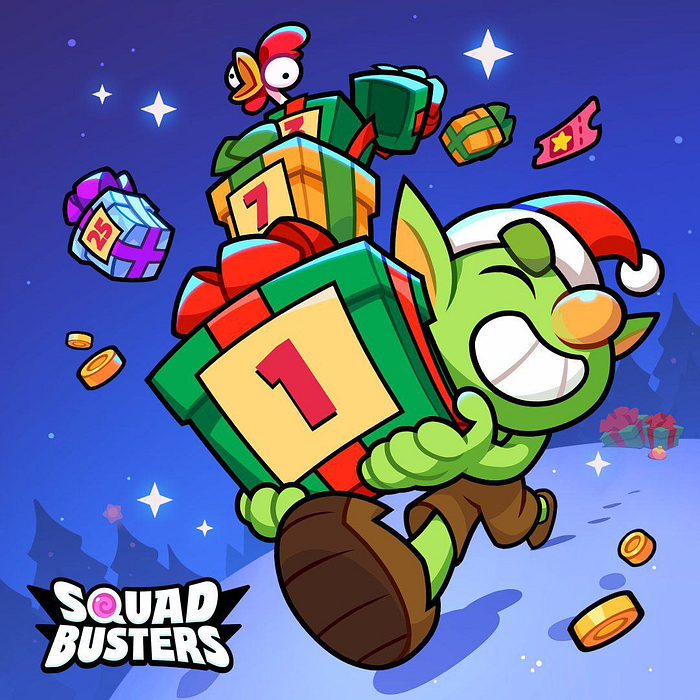
Alright, take a deep breath. We’ve got a lot to get through before we say goodbye to 2024. December rolled in, and like clockwork, all of Supercell’s games got their holiday makeover. For its first Christmas, Squad Busters didn’t hold back - players got a full Advent Calendar from the 1st to the 25th. But that, as it turned out, was just the warm-up.
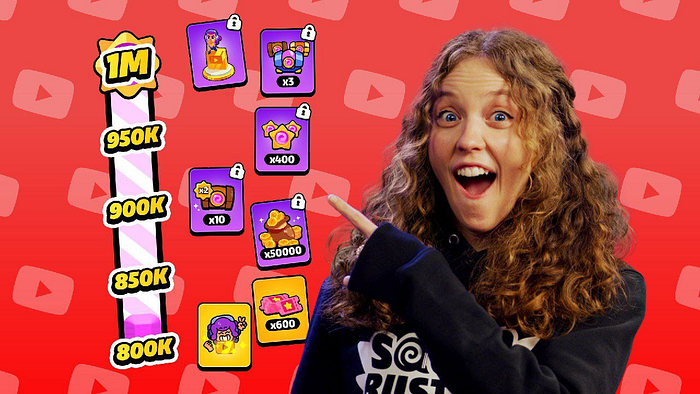
• The “Million Subscribers in Hours” Craze: On December 9th, the devs posted a wild idea: what if we all sub to the official Squad Busters YouTube channel? The goal was 1 million. Sounds like a stretch, right? Well, hold on. Before the post, the channel had about 810k subs. In just six hours, it smashed past the million mark. The team was shocked - they thought it would take weeks. Riding the high, they immediately set a new, crazy goal: 2 million subs. (Spoiler: they never hit it).
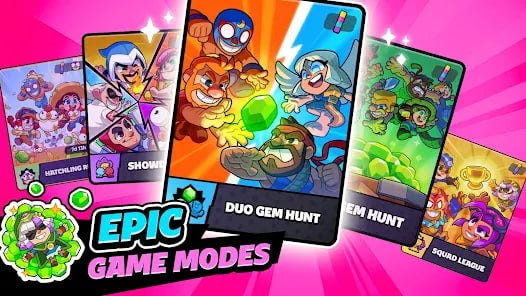
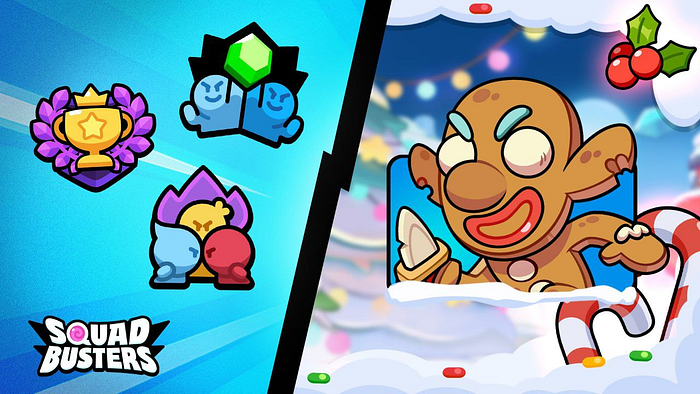
• The “Squadmas” Update: On December 14th, a big “Squad UPdate” landed. They added new modes like Showdown and Duo Gem Hunt, killed the win streak, and rebalanced some squads. But here’s the real talk: in the same announcement, they said there’d be no new characters or worlds for a while, and that updates would slow down. It felt like the party was starting to wind down.
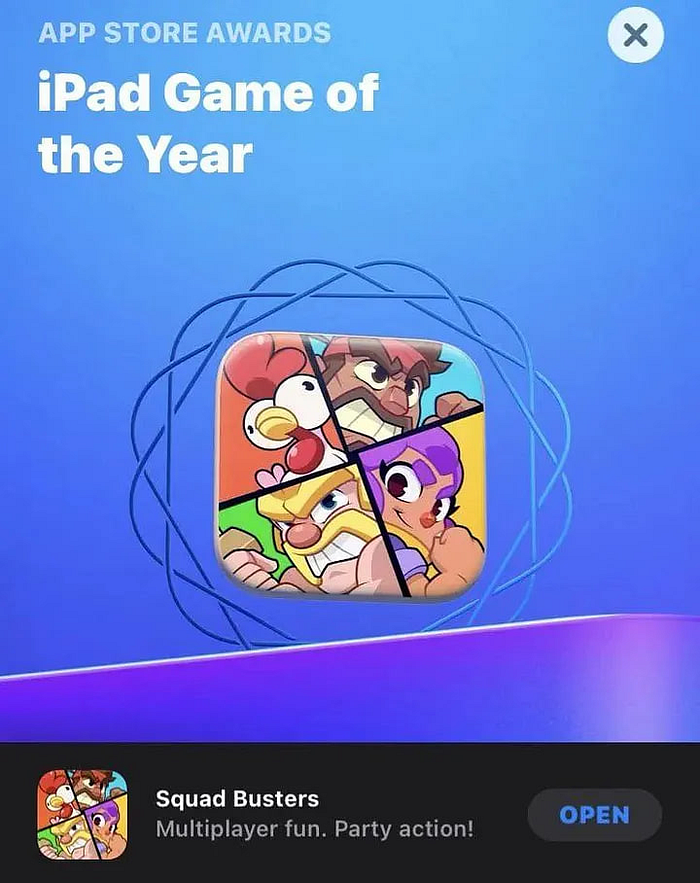
• Ironic Victory Lap: In a weird twist of fate, Apple named Squad Busters “iPad Game of the Year”. A trophy that felt like it was for the game we had back in June, not the one limping into December.
So, With All That Hype… What Actually Happened?
Let’s look at the stats. After a community frenzy, a big update, and a fancy award, this is what December’s report card looked like:
Revenue actually fell again, dropping $1.2 million to $2.8 million.
Downloads ticked up slightly from 700k to 800k. A small win, I guess?
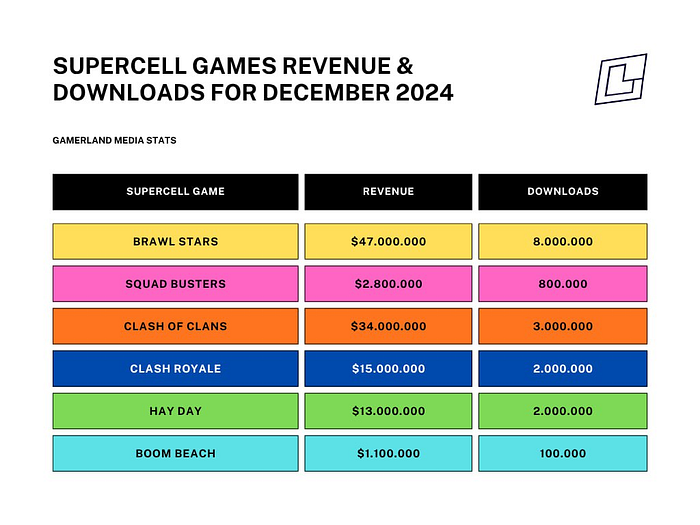
And here’s the kicker - this was Christmas. The time when every other Supercell game was printing money. While others saw holiday spikes, Squad Busters kept fading. It’s the perfect, sad summary of the whole year: they could still create a moment of buzz (like that YouTube sprint), but they couldn’t translate any of it into lasting success or revenue. The lights were on, the tree was decorated, but hardly anyone was home.
The 2024 Post-Mortem - A Year of “What If?”
Okay, let’s take a step back. We’ve just walked through the entire rollercoaster of 2024, month by painful month. From the stratospheric highs of June to the quiet, Christmas-colored sigh of December. Now, let’s compile the complete scorecard for the year and ask the big question: what the heck happened?
First, the cold, hard totals. And honestly, the best way to see this story isn’t in a paragraph - it’s in a picture. One look at these charts says it all:
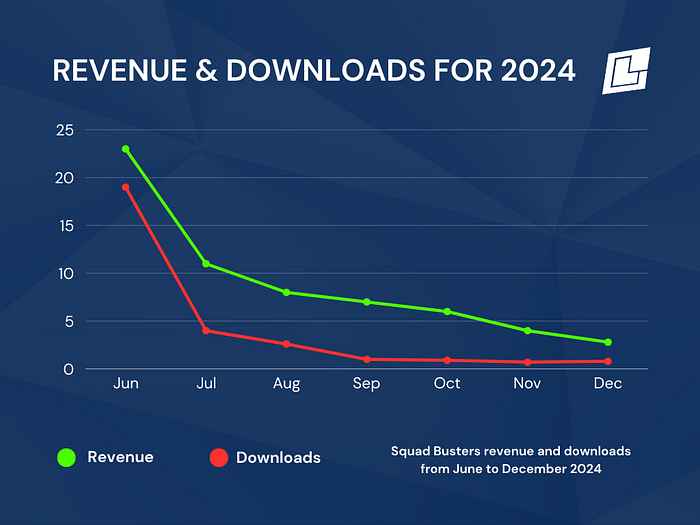
It’s the definition of a “long exhale.” A line that goes up just once, at the very start, and then spends the rest of the year sliding down. No matter what they threw at it - summer events, big updates, Transformers - the trend never reversed. Even December’s holiday cheer barely caused a blip.
But to really understand the scale, we need to talk about June. Not just as a good month, but as the month.
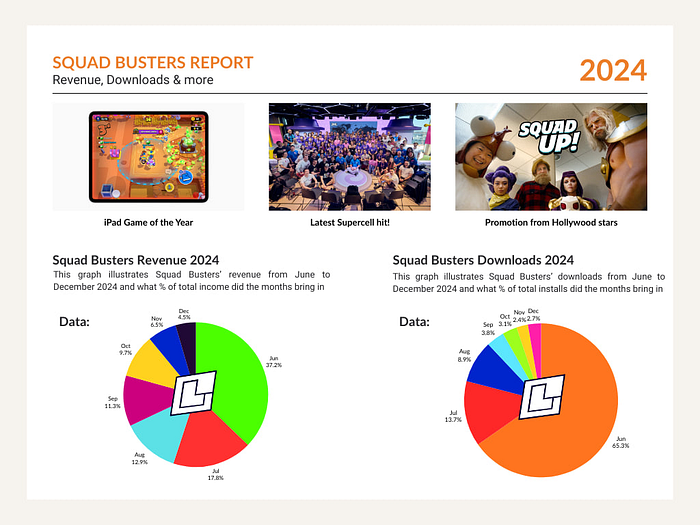
These pie charts are maybe the most brutal stats in the whole article. Let’s break them down:
• Revenue: June alone accounted for over 37% of the game’s entire income for 2024. Think about that. One month out of twelve brought in more than a third of all the money.
• Downloads: This is even crazier. 65.3% of all installs for the year happened in June. Almost two-thirds of everyone who ever trd the game did so in the first four weeks.
June wasn’t just a peak; it was the entire mountain. Everything after was just the downhill slope.
So, how did a game from the legendary Supercell, with so much hype, end up with a year defined by one single month of glory?
The answer is painfully simple, and we’ve seen it play out in every chapter: Squad Busters only nailed the first step.
Step 1: The Marketing Masterpiece (They absolutely crushed this). The hype was unreal. The first new global Supercell game in 5.5 years? A crossover with all your favorite characters? Trailers with Hollywood stars like Chris Hemsworth? A blitz of 24,000 ads across the globe? It was a perfect storm. They made the whole world aware, and 19 million people rushed to download it. They even won “iPad Game of the Year”! On paper, it was a launch for the history books.
Step 2: The Game Itself (This is where it all fell apart). All that marketing genius funneled millions of players into a game that… well, that many found kind of boring after a while. The “cool factor” of mixing universes wore off fast. The updates and events were fine, but they were just putting new paint on a car with a faulty engine. The core gameplay loop couldn’t hold people. Remember July? The very next month, revenue was cut in half and 15 million players vanished. They came for the hype, but they didn’t stay for the game.
In the end, 2024 was the year of a spectacular, beautiful, incredibly expensive flash in the pan. It was a lesson that in mobile gaming, you can buy attention, but you can’t buy love.
And if you think 2024 was bad… well, buckle up. 2025 is where the real endgame begins. The numbers get small, the updates get desperate, and the story of Squad Busters moves from a drama to a quiet, drawn-out farewell.
CHAPTER 3. THE FINAL BREATH BEFORE THE STORM
3.1. January-February 2025: The Quiet Agony and a “Pre-Death Pause” Before the Last Bet
If in December 2024 the game was still trying to smile and hand out gifts, the first two months of 2025 became that very “pre-death pause” we talked about. A time when everyone - the players, and it seems, Supercell itself - froze, waiting for the final, decisive move.
January: Nothing Personal, Just a Decline. January “didn’t work out.” The main events of the month? Adding a “Video” tab, announcing the Lunar New Year holiday, and… a vote for one of three characters to level up faster. That’s it. When the main highlight of the month is a vote for a future upgrade, things are clearly bad.
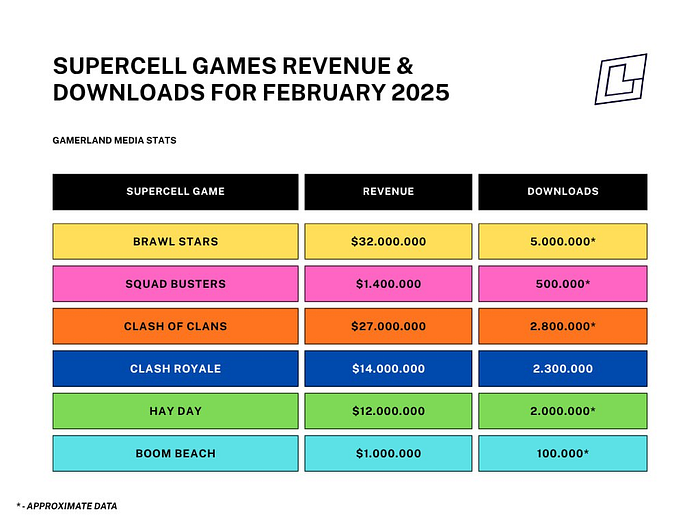
What do the numbers say? The statistics from our charts confirm this with cold numbers. After December’s $2.8 million, revenue in January halved to $1.5 million. Downloads dropped from 800,000 to 600,000. The context is terrifying: while Brawl Stars was steadily earning $35 million, their new “crossover hit” was bringing in 23 times less. In terms of revenue, the game was practically on par with Boom Beach - a project that exists more out of inertia.
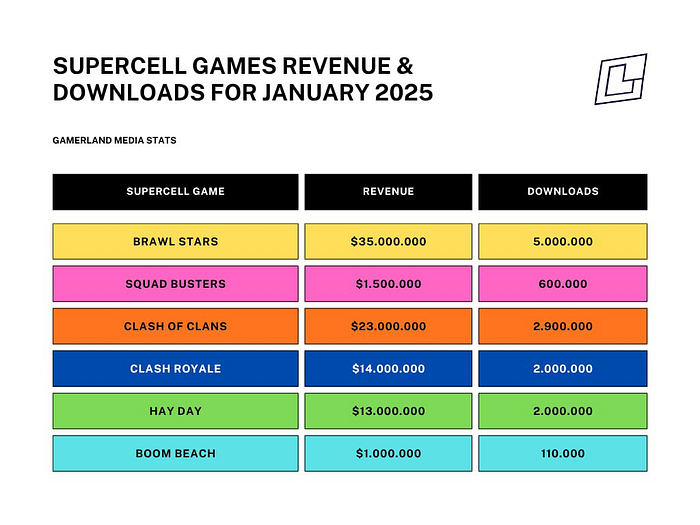
February: A New Manager, Old Problems. An update on February 15th was supposed to inspire hope: a new community manager Adrian was introduced, the “Hatchling Run” mode was added, along with new skins. But the main thing wasn’t that, it was the Roadmap for 2025.
The Roadmap as a Verdict: The team outright stated that the February update was small because all efforts were thrown into the April update, which would “turn the game upside down” (their future “Squad Busters 2.0” with heroes). Essentially, this was a public admission: “Yes, the current state of the game doesn’t satisfy you, or us. Hang in there, we’re trying to break everything and remake it”
Market Reaction: The players and the market read this “pause” unequivocally. Statistics for February barely changed: revenue slightly dipped to $1.4 million, downloads to 500,000. That 100,000 difference isn’t a drop; it’s stagnation in the near-zero zone. The game had reached a “death plateau” - the minimum level below which you don’t fall anymore, because everyone has left except for the most dedicated, small core of fans.
The Two-Month Conclusion:
These weren’t just quiet months. This was a conscious and publicly announced moratorium on developing the current version of the game. Supercell officially drew a line under “Squad Busters 1.0” and asked the remaining players to wait for salvation in the form of “2.0”. The financial metrics went from alarming to symbolic. All the team’s energy went into the secret labs to work on the “Heroes.” January and February 2025 became that deep silence that only happens right before the loudest, most desperate, and final explosion.
3.2. March-April 2025: Hitting Rock Bottom and the Last Storyteller’s Trick
After the February roadmap promised a world-changing update for April, the game entered its final period of eerie calm. The developers had gone completely silent, asking for patience while they built the future. But as March and April dragged on, the silence wasn’t filled with anticipation - it was filled with the deafening sound of a game hitting its absolute rock bottom.
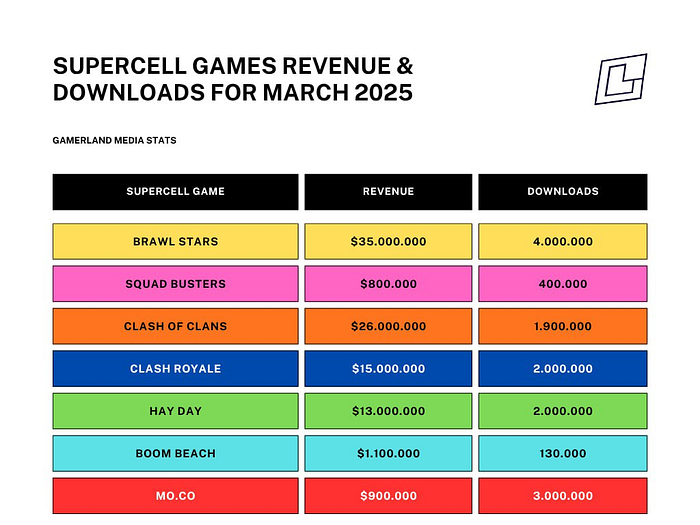
March 2025: A Grim Milestone and the Ultimate Insult. If February’s statistics were a “death plateau”, March was the burial. For the first time in its history, Squad Busters’ monthly revenue crashed through the $1 million floor, landing at a pitiful $800,000. Downloads were a stagnant 400,000. The “core audience” was now a rounding error. But the real kicker, as our chart shows, wasn’t just internal decay - it was external replacement. In mid-March, Supercell globally launched mo.co, its next new game. Within just two weeks, it instantly surpassed Squad Busters in revenue ($900k vs. $800k) and racked up 3 million downloads. The message from the company couldn’t be clearer: the future was no longer Squad Busters. It had been publicly succeeded while it was still technically alive.
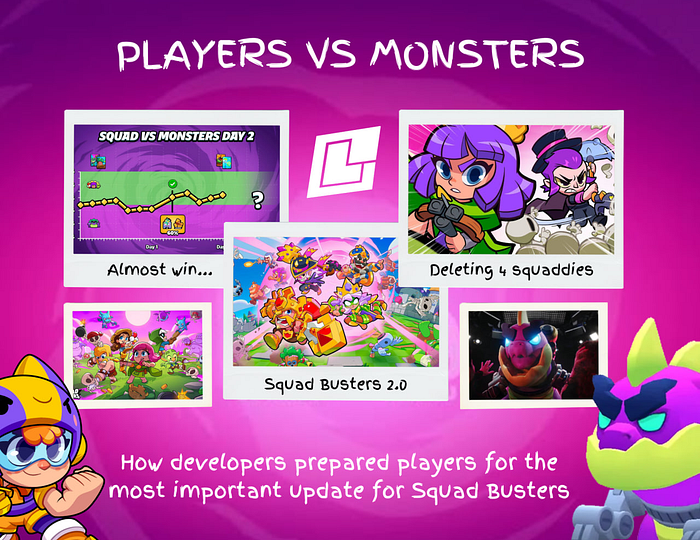
April 2025: The Story No One Was Paying To See. On paper, April was identical to March: $800,000 revenue, 400,000 downloads. The game was in a financial coma. Yet, finally, the promised narrative began. At the end of April, the developers tried one last, desperate trick: they started removing beloved characters like Mortis and the Archer Queen, framing it as a monster invasion. The goal was to create buzz, mystery, and hype for the May “2.0” rebirth.
The result? Nothing. The player base was so small and disengaged that this dramatic, risky storytelling stunt caused zero statistical movement. The scale in the game showed the monsters “winning,” and in a meta sense, they already had. The most telling review of this prelude wasn’t in an article, but in the flatlined revenue chart.
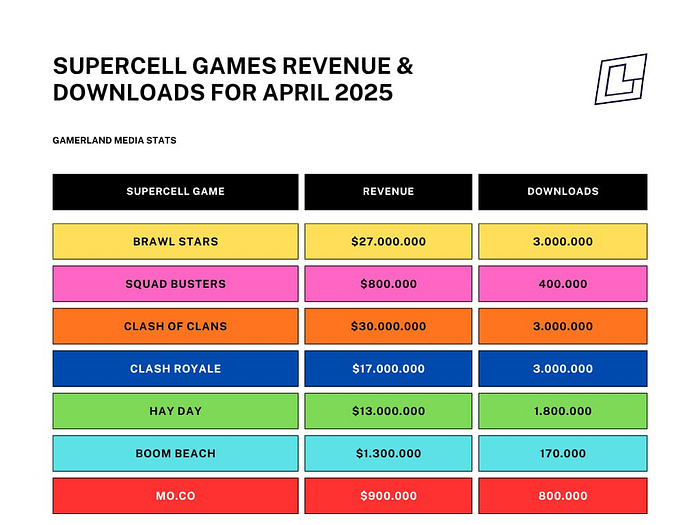
The Verdict:
The “calm before the storm” of the April/May update was, in reality, the quiet after the defeat. March proved the game had hit its financial bedrock and been abandoned by its own creators for a newer project. April proved that even clever narrative could no longer reach an audience that had already left. The stage was set for the May update not as a savior, but as a final, formal experiment on a patient who was already clinically dead.
3.3. May 2025: Squad Busters 2.0 - The Pyrrhic Victory of the Last Stand
As promised, May arrived not with a whisper, but with the long-awaited earthquake. On May 9th, Supercell dropped the “Squad Busters 2.0” update - a complete overhaul designed not to tweak, but to resurrect. After months of silence and decline, this was their final, all-or-nothing bet on the game’s core identity.
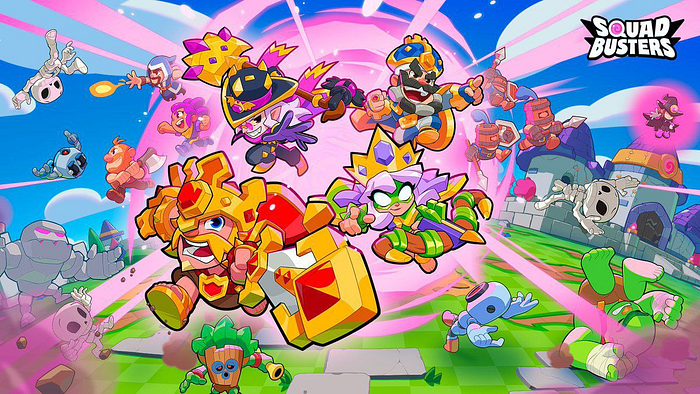
The “Heroes” Update: A Foundation Rebuilt. The update’s heart was the new Heroes rarity. Those characters “eliminated” in April - Mortis, Archer Queen, Barbarian King, King Royale - returned as powerful squad leaders. This wasn’t just adding content; it was redesigning the game’s spine. The hero became the linchpin: lose them, and your entire squad falls. Progression shifted to dedicated Hero Points, earnable primarily through gameplay (“grinding”), with a conscious de-emphasis on direct pay-to-win purchases (outside the Gem Pass). This created a clear, honest motivation loop: play more to strengthen your chosen hero. Spells and some modifiers were removed to refocus the combat around this new dynamic. For the dedicated players who remained, this was a revelation - the game finally had the strategic depth and clear progression it lacked at launch.
The Statistical Mirage: A Fleeting Pulse. So, did this massive surgical operation work? The answer, for the first time in nearly a year, was a hesitant “yes, but…”.
The Good News: Revenue, after hitting rock bottom at $800,000, finally climbed back to $1 million. Downloads increased from 400,000 to 600,000. After ten consecutive months of decline, any upward movement felt like a miracle. It proved the update did re-engage the hardcore base and attract a flicker of returning interest.
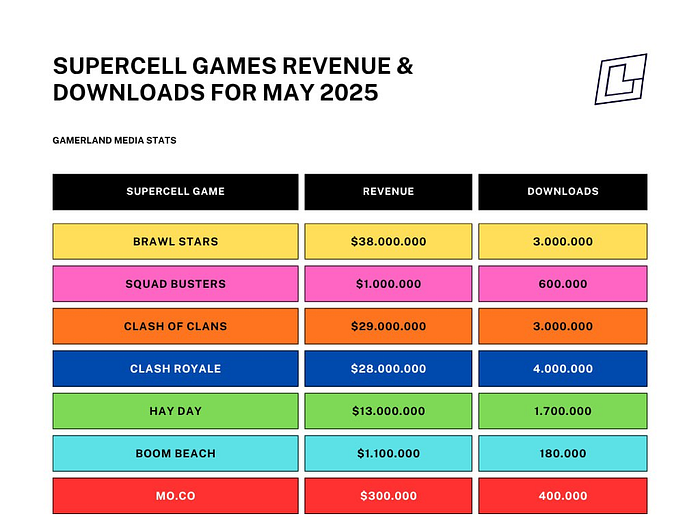
The Sobering Reality: Context is everything. A 25% revenue increase from the absolute bottom is a statistical rebound, not a revival. To put it in perspective: Brawl Stars’ revenue that month was $38 million. Squad Busters 2.0, at its triumphant peak, was generating less than 3% of what its stablemate earned routinely. The “surge” merely returned the game to the disastrously low levels of January-February 2025. The player base, though growing, was still a fraction of its former self.
The Verdict: A Victory That Proved the Rule
The May 2025 update was the best version of Squad Busters ever released - polished, more strategic, and fairer. And that was the tragedy. Supercell finally fixed the game, but it was too late for almost everyone. The monumental effort required for “2.0” resulted in what can only be called a Pyrrhic victory: a win so costly, it felt like defeat. It stabilized the patient’s vitals but couldn’t reverse the terminal diagnosis of mass player abandonment. The modest bump proved that a fantastic update could no longer generate fantastic numbers. The trust, the hype, and the mainstream audience were gone for good.
This sets the stage for the cruelest twist: the “last major surge” in June, which we now know wasn’t a new beginning, but the final, brief flash before the lights went out for good. The long goodbye was entering its final chapter.
3.4. June 2025: The Last Hope and Sonic’s Farewell
It seemed Squad Busters had one final chance. In June 2025, the game received, without exaggeration, its loudest and most nostalgic piece of content yet - a major crossover with the Sonic the Hedgehog universe. For the community, it was an electric shock: Sonic, Tails, and Knuckles burst onto the scene, accompanied by a completely new world reimagined in the aesthetic of the famous franchise.
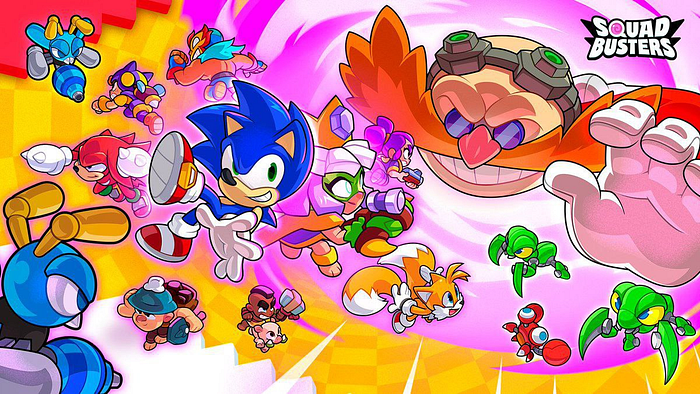
The reaction was instant and euphoric. On forums and social media, players hailed this update as a “lifeline” and the “best in the game’s entire history.” For a brief moment, the game once again buzzed with the excitement and thrill of its early days. Many believed this powerful cultural crossover would finally break the sad trend. However, the cold, hard stats, as they often do, told a different, more sobering story.
Financially, the game barely held on to the $1 million revenue mark, matching its May result. But the real wake-up call came from the download figures. Despite the power of the Sonic brand, the number of new installs dropped from 600,000 to 400,000. The collaboration succeeded in capturing the attention of dedicated fans but failed completely in its primary mission: to attract a massive new audience or bring back former players.
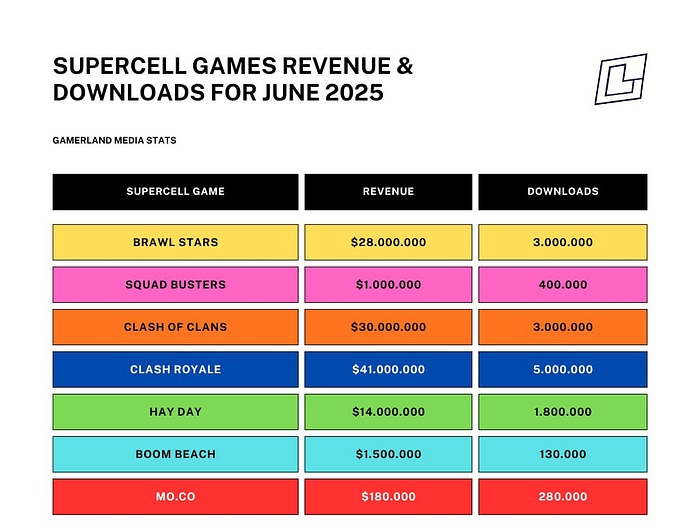
This month became the fatal point of no return. While previous slumps could be blamed on seasonality or a content drought, the cause was now clear to everyone: even the best content the game had ever seen was not enough to stop its downward spiral. June 2025 did not just fail to be its salvation - it delivered the final diagnosis. The joy of the Blue Blur’s arrival was short-lived, followed by the grim realization of the inevitable: for the last time, the game broke even, and only decline lay ahead.
3.5. July–October 2025: The Quiet Fade and the Road to Nowhere
After the June flare-up with Sonic, a silence fell. A silence so profound you could hear the numbers dropping in the spreadsheets. The summer of 2025 became a time of a strange, almost absurd paradox for Squad Busters. The developers kept working, but the players kept leaving. It felt like watching someone carefully decorate a house that was already on fire.
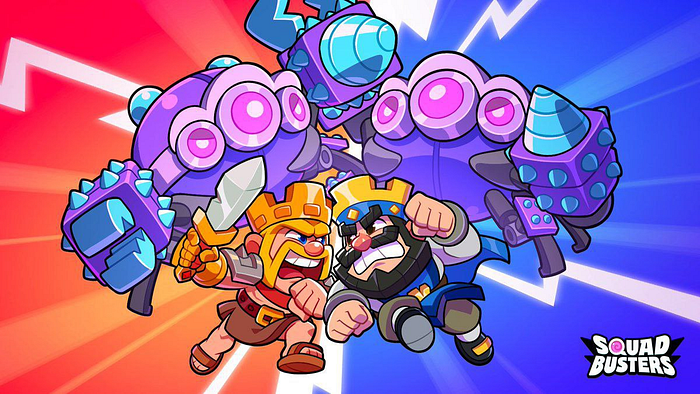
The Summer Slide: When “Fine” is a Disaster
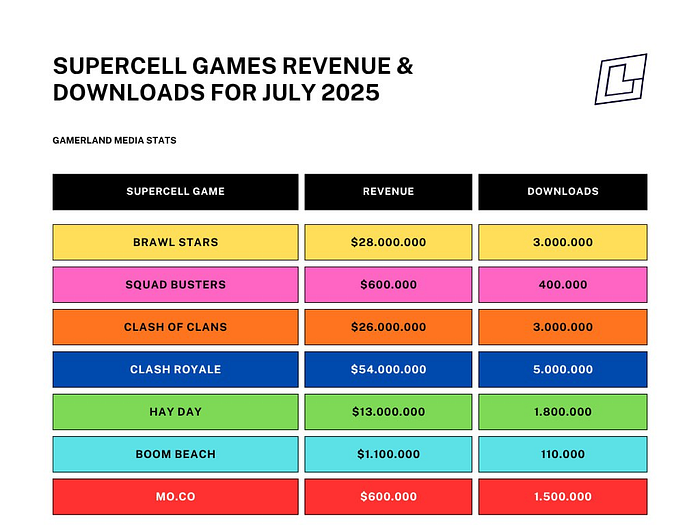
July set a grim new standard. They released Spike, a solid, classic hero. But the reaction? A collective sigh. Revenue didn’t just fall; it crashed by 40% to $600,000. Downloads were stuck at 400,000 - a flatline on the chart. This wasn’t a problem with a specific update anymore; this was the new, miserable normal.
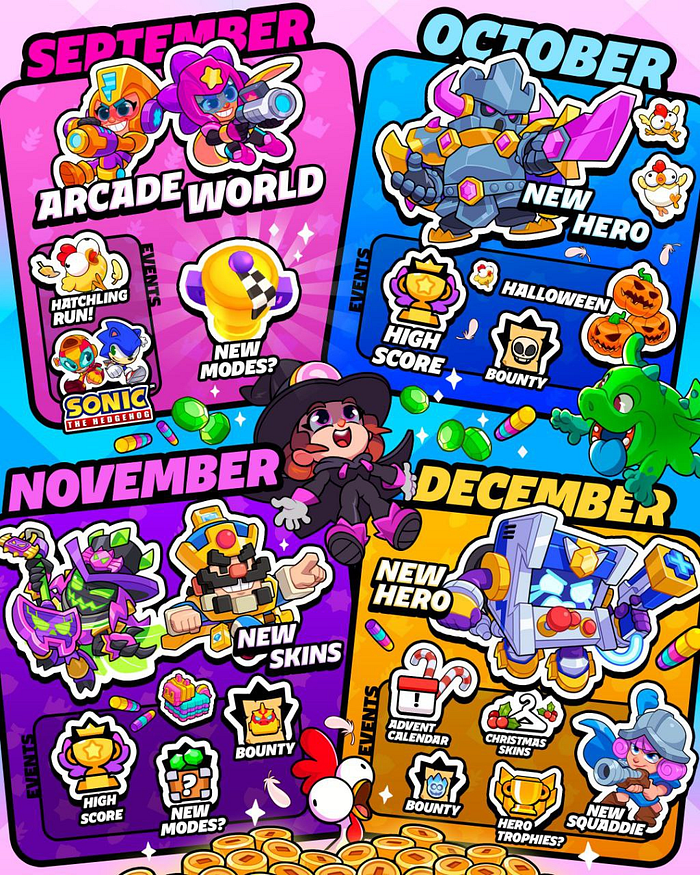
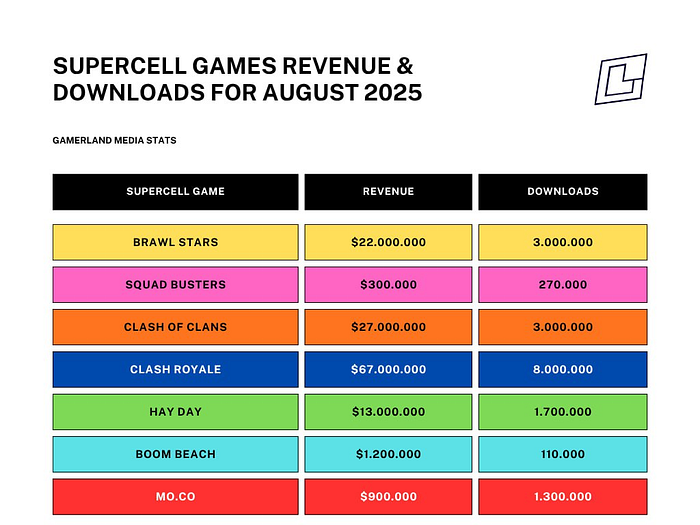
Then, at the end of August, they released a Roadmap. A beautiful, colorful chart promising a new world in September, a P.E.K.K.A. hero in October, and festive modes all the way to Christmas. Looking at it felt surreal. Here was this detailed plan for a future, announced in the same month the game earned just $300,000 - less than some indie mobile titles. The community’s reaction wasn’t excitement, but a sad, ironic melancholy. “They’re still planning Christmas,” people wrote, “but will anyone be left to celebrate it?”
Autumn Content on a Ghost Ship
The team, true to their word, delivered. September brought the Arcade World and teased the new hero, P.E.K.K.A. The update was… fine. Competent. But “fine” for a game in this state was like putting a fresh coat of paint on a sinking ship. The numbers told the real story: revenue stagnated at $190,000, downloads froze at 170,000. The game wasn’t just shrinking; it was fossilizing.
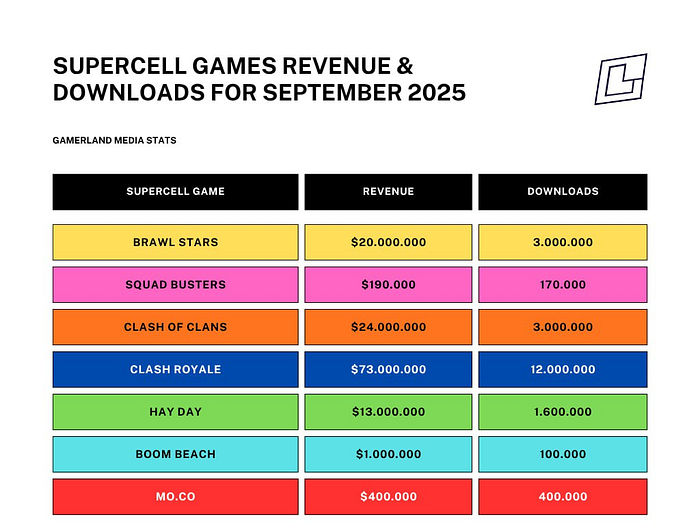
And then came October. Mid-month, they finally released P.E.K.K.A., a heavyweight icon from Clash Universe. It should have been a moment of triumph. Instead, it was the final, tragic punchline. Because by then, looking at the stats was like looking into a black hole.
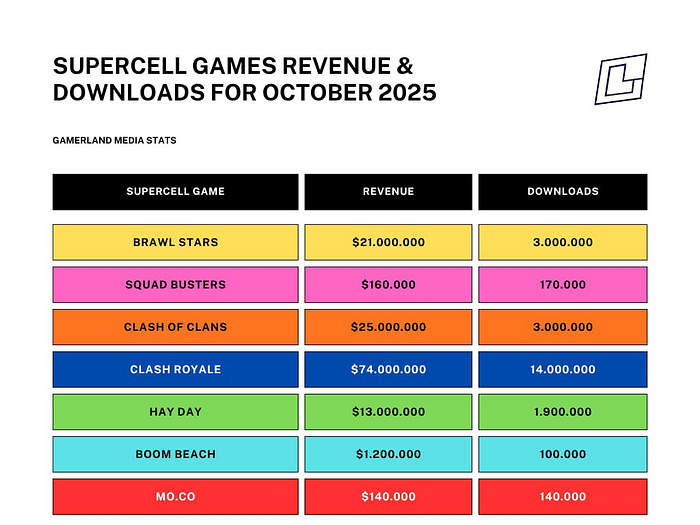
The real story of these months wasn’t just Squad Busters’ decline, but its utter irrelevance in its own family. Take October’s data: Squad Busters scrapes together $160,000. That same month, Clash Royale generates $74,000,000. Let that sink in. The failing game earned over 460 times less. Its 170,000 downloads were a statistical error next to Clash Royale’s 14 million. It was a brutal, unanswerable comparison. The problem wasn’t the market, it wasn’t Supercell’s marketing - it was the game itself. It had lost its reason to exist.
The Inevitable
And so the stage was set for October 30th. There were no more heroes left to release, no worlds to unveil. The colorful roadmap had been followed to its last point. All that remained was the quiet, the stagnant stats, and a community waiting for the other shoe to drop. The updates had ended. All that was left was the news.
CHAPTER 4. SQUAD BUSTERS - KILLED!
4.1. The Official End of an Era
The news, when it landed on October 30, 2025, felt like the final, quiet sigh after a long, drawn-out struggle. Supercell made it official: development on Squad Busters was ceasing. The in-game store was disabled although the latest update will still be released in December, thereby completing the roadmap.
This wasn’t a dramatic, overnight shutdown. It was the administrative period at the end of a story that had already been written in the monthly revenue charts. For the community still hanging on, the announcement was met with a mix of sadness and resignation. The final October numbers said it all: a meager $160,000 in revenue and 170,000 downloads. To put that in perspective, in that same month, Clash Royale generated $74 million - over 460 times more. Squad Busters had become a statistical footnote within its own company.
4.2. The Core Reasons for the 99.3% Collapse
So how did a game that launched as the most-downloaded title in Supercell’s history, topping charts and generating $23 million in its first month, end up here? The collapse wasn’t due to one mistake, but a perfect storm of critical failures.
1. The Hype Machine vs. The Gameplay Loop
The launch was a masterpiece of marketing. Supercell unleashed over 23,776 ad creatives across 12 platforms, leveraging its beloved characters to generate unprecedented curiosity. This resulted in a record-shattering 19 million downloads in June 2024. However, this was the game’s first and biggest trap. It brilliantly solved the problem of acquisition but failed at retention. Players downloaded the game for the “Supercell crossover” fantasy, but many found the core auto-battler gameplay repetitive and lacking the strategic depth needed for long-term engagement. The marketing pulled people in, but the gameplay couldn’t keep them.
2. The Fatal Monetization Mismatch
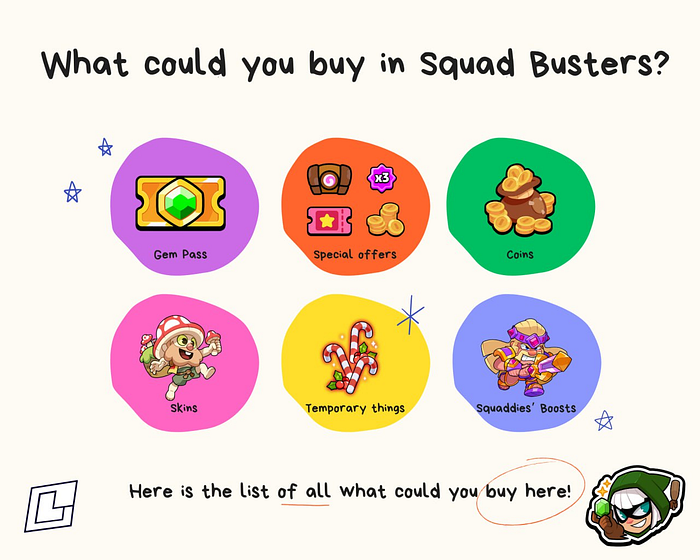
The financial data from the very first month was a glaring red flag. Despite massive downloads, Squad Busters ranked only third in revenue behind Clash of Clans and Brawl Stars. This pointed to a disastrously low monetization per user. The in-game store offered little of real value or urgency. The Gem Pass was useful, but special offers often contained items players could earn easily for free. There was no compelling “must-have” purchase to drive spending, leading to a player base that was wide as an ocean but shallow as a puddle when it came to revenue.
3. The Impossible Chase and Content Fatigue
The development team fought valiantly against the tide. They released new worlds (Lava, Arcade), held events (Hatchling run), and secured major collaborations (Transformers in September 2024, Sonic in June 2025). Each update provided a tiny bump or slowed the decline briefly, but the underlying trend never reversed. These efforts felt like applying band-aids to a critical wound. The content was good, but it couldn’t fix the fundamental issues with the core game loop and monetization. Players were treating the game as a casual novelty to check out during updates, not a main game to invest in.
4. The Shadow of Giants and Internal Competition
Ultimately, Squad Busters was killed by comparison - both to Supercell’s past and its present. Its first-month revenue of $23 million paled next to Clash Royale’s $136.5 million (2016) or Brawl Stars’ $63.4 million (2018). It failed to meet the internal “Supercell bar” for a hit. Furthermore, as Squad Busters faded, other Supercell titles not only survived but thrived. In its final months, it was clear the company’s resources and player loyalty remained firmly with its legacy titans. Squad Busters didn’t just fail to find a sustainable audience; it failed to justify its existence in a portfolio of enduring giants.
Conclusion: A Legacy of Lessons, Not Profits
The closure of Squad Busters is not a story of abject failure, but a masterclass in market realities. It proved that even the most powerful brand hype, the biggest marketing budget, and the most recognizable characters cannot save a game that hasn’t cracked the code of lasting engagement and fair, compelling monetization. For Supercell, it was another tough but disciplined decision to “kill their darlings,” a philosophy that has kept their portfolio sharp. For the industry, it stands as a stark reminder: in the mobile gaming arena, a spectacular launch is just the first step. The real battle begins on day two.
4.3. Squad Busters after news - November 2025
If October 30th was the official end, then November 2025 was the post-credits scene - one last, strange twist in the data.
The figures for the month are almost surreal. With all in-game purchases disabled and the title removed from stores, Squad Busters reported a final revenue of just $12,000. This minuscule sum, likely from residual subscription transactions or refund adjustments, underscores the absolute end of its commercial life. The dream of monetization was officially over.
But then, there’s the other number. The one that defies easy logic. Downloads skyrocketed to 1.9 million.
This is the final, haunting paradox of Squad Busters. After the announcement of its closure, more people downloaded the game in one month than in the preceding four months combined. It was as if the game’s death certificate sparked a final, global moment of collective curiosity and nostalgia. Players rushed to try it “one last time” before it might vanish forever, or simply to see for themselves the world that once promised so much.
This creates a deeply ironic and poignant question for us to end on: What did these 1.9 million new players in November find in the dying game that the 19 million who left in its first month could not?
Did they discover a hidden gem, overlooked in the rush? Or did they simply confirm the core thesis of this entire story: that Squad Busters was a spectacular phenomenon of marketing and first-click appeal, a “Supercell museum” that was fascinating to visit once, but not a living world worth staying in?
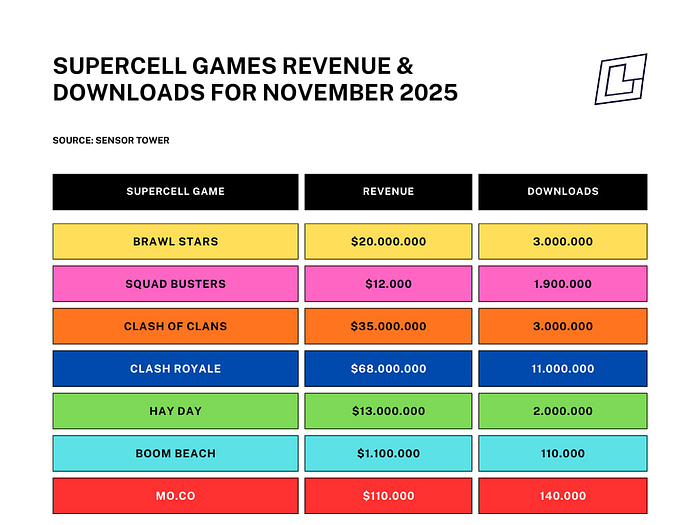
The November spike is not a sign of life. It’s the final, powerful data point that captures the game’s essence: unmatched ability to attract attention, and a fatal inability to convert that attention into a sustainable future. The ghost of the game, for one last month, topped the download charts again. But the house was already empty.
4.4. Squad Busters full results in 2025 - The story came to an end…
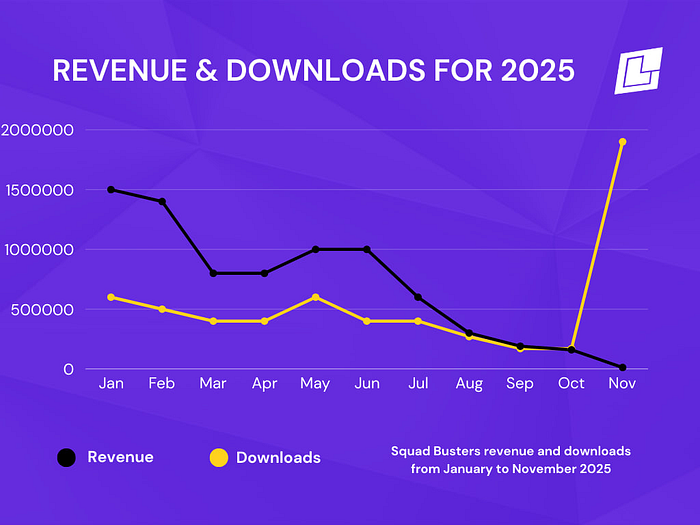
If you had to explain the life and death of Squad Busters to someone in just ten seconds, you wouldn’t need words. You’d just show them the revenue and download chart for 2025. It’s not a graph; it’s a storyboard. A story that starts with a struggle, moves into desperation, and ends with one of the weirdest twists in mobile gaming.
The Slow, Painful Fade
Let’s be honest, 2025 wasn’t a year of growth for Squad Busters; it was a year of managed decline. You can see it in the data. The first half of the year was the game on life support. Months like April, May, and July each brought in about 10% of the year’s total income. That sounds okay until you remember this is a Supercell game we’re talking about - the standard isn’t “okay,” it’s “phenomenal”.
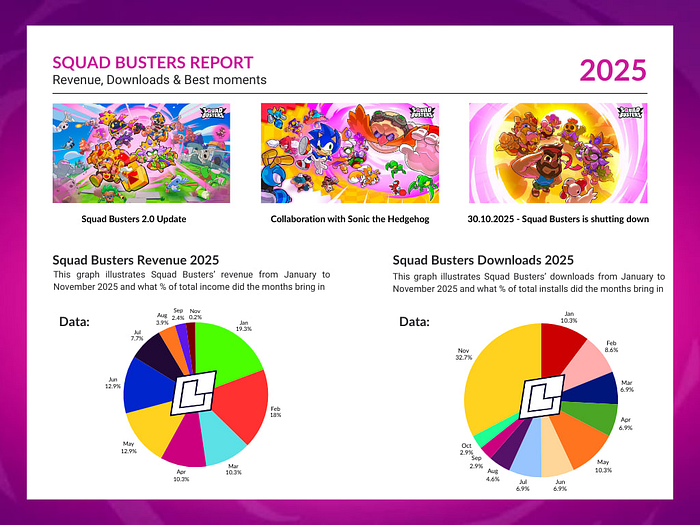
Then came the Sonic collaboration in June. You can see the little bump of hope there; it accounted for 12.9% of the year’s revenue. For a moment, it felt like a turnaround. But it was just a sugar rush. By August (3.9%) and September (4.6%), you can see the energy vanish. The developers were pushing out content, but the player base’s wallet was already closed.
The Bizarre Aftermath
Then, the line on the revenue chart falls off the page. October contributed a pathetic 0.2% of the year’s income. That’s the month they officially pulled the plug.
But then… look at the download chart for November (pic. 27). This is the part that makes you scratch your head. After the death announcement, downloads skyrocketed to 1.9 million - one of the biggest spikes of the entire year! More people downloaded the dead game in November than in the previous four months combined when it was still alive.
How Supercell lost $80.000.000 on Squad Busters?
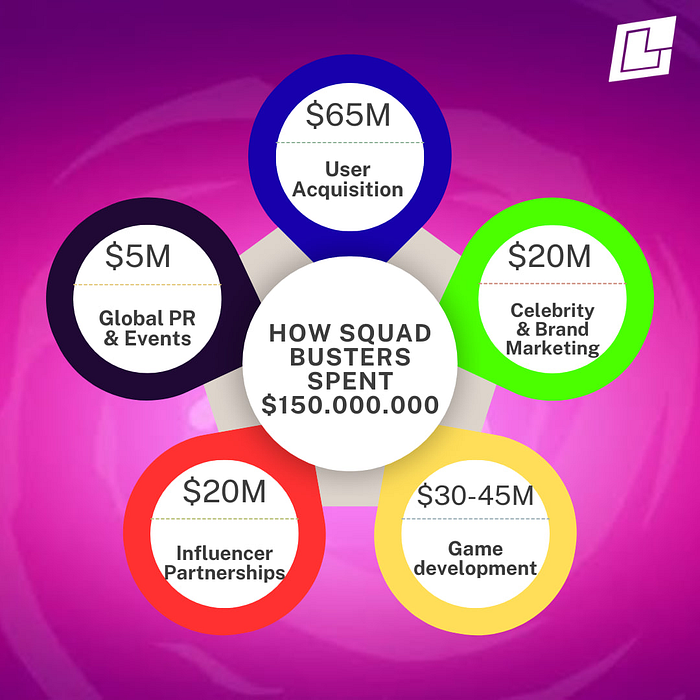
Okay, let’s talk about the only thing that matters in the end: the money. Because when you strip away all the hype, the Hollywood ads, and the flashy trailers, that’s the cold, hard reality that decided the fate of Squad Busters. Get ready for this number: $150 million.
That’s not a typo. According to a deep-dive analysis by industry experts, that’s roughly what Supercell invested into the whole Squad Busters experiment. For a company famous for its restraint, for killing games that aren’t perfect, this was a seismic shift. They didn’t just launch a game; they tried to buy a global phenomenon.
Now, get ready for the other number, the one that makes you wince: about $70–72 million.
That’s the total revenue the game is estimated to have pulled in before it was shut down. Let that sink in. They spent one hundred and fifty million dollars to make seventy million back.
Think of it like this: imagine throwing the most expensive, star-studded party the world has ever seen. You rent out a stadium, fly in A-list celebrities, and flood every screen with ads. For one wild night, the place is packed. But then people start leaving. And when you check the register at the end, you’ve made back less than half of what you spent on the party itself. That’s the Squad Busters story in a nutshell.
So, where did all that money go? It wasn’t just on making the game. That was the smaller part. The real cash was burned on making sure every single person on the planet heard about it.
~$65 million was spent just on buying installs - paying to get the game on people’s phones.
~$20 million went to Hollywood talent and making those cinematic ads.
Another ~$20 million was for influencers and creators to shout about it.
Game development cost $30–45 million.
The math here is brutally simple, and it’s the loudest alarm bell in this whole story. You can have the biggest launch in mobile history. You can get 60 million downloads. But if you spend more than twice as much as you earn, you haven’t built a game - you’ve financed a spectacularly expensive lesson.
And that lesson is clear: you cannot buy a lasting hit. You can buy attention, but you can’t buy a soul. Squad Busters proved that even with a blank check, the old rules still apply. The game needs to be good enough - compelling enough - to make people stay and play (and pay) long after the marketing fireworks have fizzled out.
For Supercell, those missing $80 million dollars are the price tag for finally breaking their own fear of failure. For the rest of us, it’s the most expensive case study on the planet about the difference between a launch and a legacy.
And you may ask me: How Squad Busters lost 99.3% of their revenue? Where do these figures come from? It’s very simple, using the proportion method: 160k*100%/23M = 0.69%. And now 100% - 0.69% = 99.31%, which is exactly how much the game lost in 18 months.
FINAL WORDS. CONCLUSION
So, what do we do with this story? With these charts that look like a crash test? With the bizarre fact that a game found its biggest new audience after it was pronounced dead?
I think the final, quiet lesson of Squad Busters isn’t in the loud launch or the sad decline, but in that strange, silent November spike. Those 1.9 million downloads after the closure announcement are the purest data point of all. They tell us that curiosity, nostalgia, and FOMO (fear of missing out) are powerful forces… but they are not the same as a sustainable game.
For Supercell, this was another hard but necessary lesson. They proved they could still orchestrate a global launch that breaks download records. But they also reaffirmed their brutal philosophy: if a game can’t find its soul, its core reason for players to stay and care day after day, then it doesn’t deserve to live, even if it’s wearing the skin of their most beloved characters.
For the rest of us watching, Squad Busters becomes the ultimate case study. It’s proof that in today’s market, you can buy almost anything: you can buy installs, you can buy hype, you can even buy attention with giant robot and hedgehog collaborations. But you cannot buy a lasting reason to play. That has to be built into the game’s heart from the very beginning.
The servers for Squad Busters might go quiet, but the question it leaves us with echoes louder: In the end, did all those millions of players, especially the last-minute November crowd, come for the spectacular fireworks of a Supercell crossover… and leave because they discovered there was no real home to stay in?
That might be the only review that truly matters.

SOURCES
- Stream Hatchet. Supercell’s Biggest Year: Squad Busters and SuperFest 2024
- SensorTower. Squad Busters’ Soft Launch Hints at Blockbuster Success
- AppGrowing. How Did Supercell’s New Game Squad Busters
- Deconstruction of Fun. 4 x Reasons Why Squad Busters Suffers While Brawl Stars Soars
- Deconstruction of Fun. Inside Squad Busters’ $150 Million Experiment
- Squad Busters Official YouTube channel
- And a little bit of our data and creativity😉
Share this article